Wall TV panel designs run from a PVC sheet and a circular saw on a Saturday afternoon to weeks of contractor time for a full built-in unit that swallows the whole wall.
The deciding factor is not budget alone but how long your layout stays fixed: renters and serial rearrangers need floating or modular options, while settled owners can commit to stone laminates or fluted MDF that stays put.
LED backlighting shows up in more than half these ideas, and the cheap controllers flicker on camera and hum when dimmed, so that is one place where saving costs more than it saves.
1. Wall-Mounted TV Panel Designs
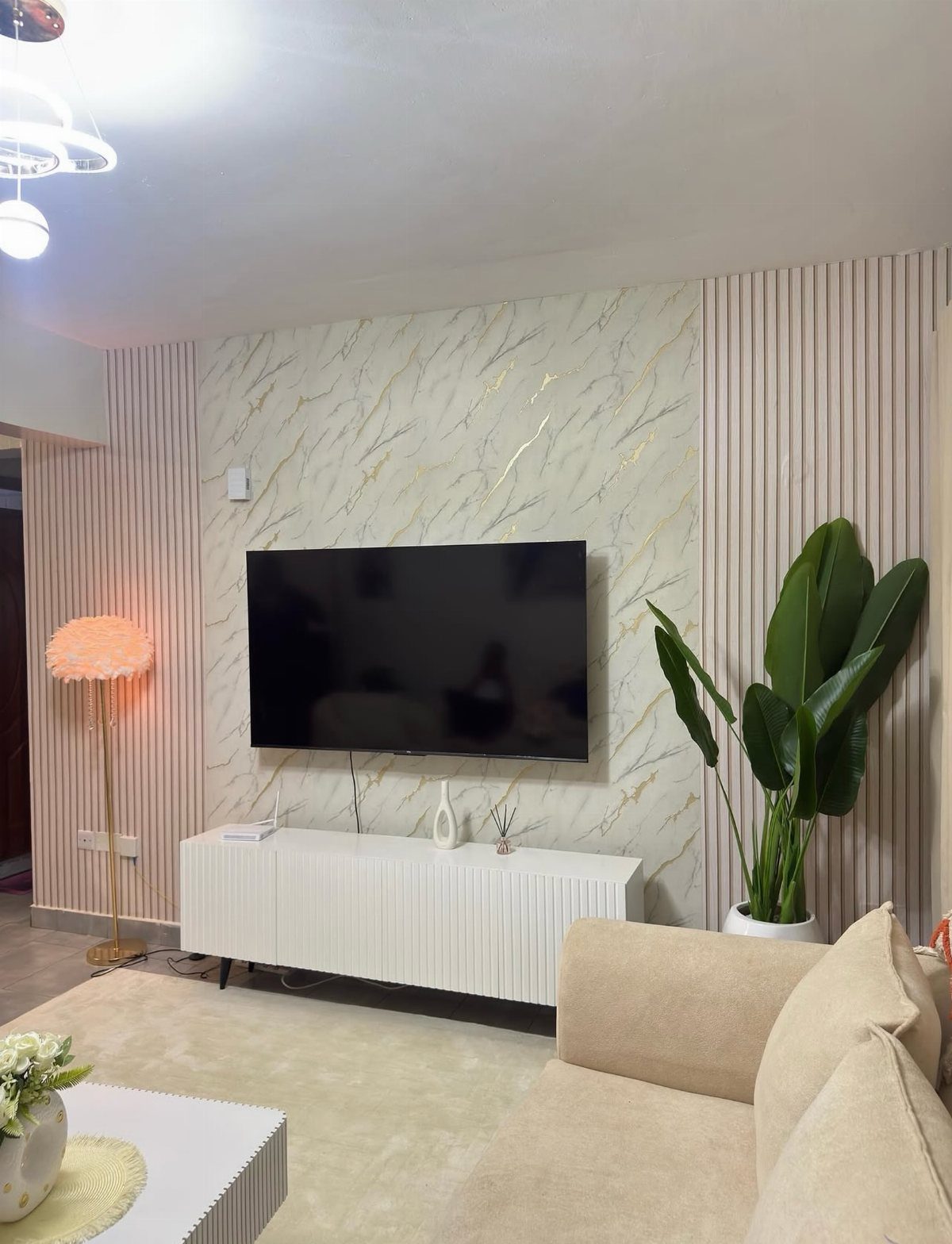
A floating mount leaves the floor clear and the room breathing. I like this for apartments where every square foot counts; the laminate back panel gives you the marble look without the weight or the cost of stone.
Choose a reflective finish if your room lacks natural light; it bounces what you have around the space. Push-to-open drawers below keep the front face clean, no hardware to catch on.
Test your viewing height before you drill: too high and your neck pays for it every movie night. Best for small living rooms where you need storage but cannot spare the footprint.

FULLY DIY NO-STUD PATENTED SOLUTION: HangSmart TV offers a complete DIY no-stud mount experience, making it a perfect choice for homeowners and renters who prefer a no-fuss,...
2. Modern Led TV Panel Design
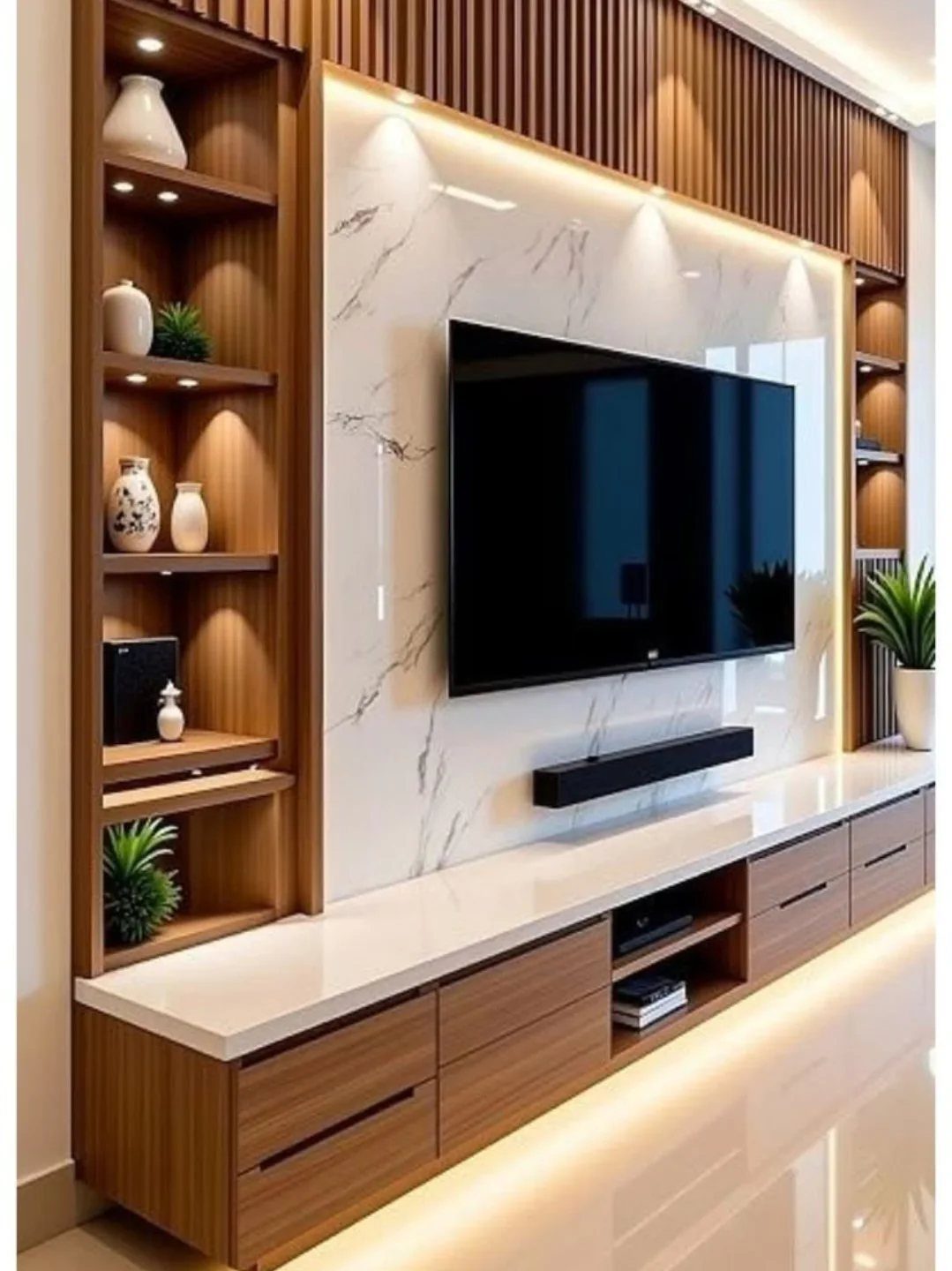
Backlighting turns the TV wall into the room’s natural gathering point after dark. The LED strips sit behind the panel, not visible, throwing a soft wash that flatters everything in front of it.
I set mine to warm white for regular evenings and dim it lower for movies; some strips let you shift color, though I find the novelty wears off fast.
A marble-look panel works with the backlight glow rather than competing with it. Budget for a quality LED controller; the cheap ones flicker on camera and hum when you dim.
This one suits renters who want drama without structural change.

SUPER BRIGHT LED BACKLIGHT SHEET - Our LED backlight sheet features 24V 36W power with 6000K cool white light & CRI 95+, delivering 3600 lumens of high-brightness light, it precisely restores stone’s natural texture and translucency. Its 19.7X9.7 inche for each sheet fits easily under countertops and walls for creating a high-end ambiance in your living room, kitchens, bars, bathroom

An ideal way to mount your Monitor or LCD panel TV to the wall,to use your space efficiently and watch your favorite TV shows comfortably!
3. Modular TV Unit with Clean Lines
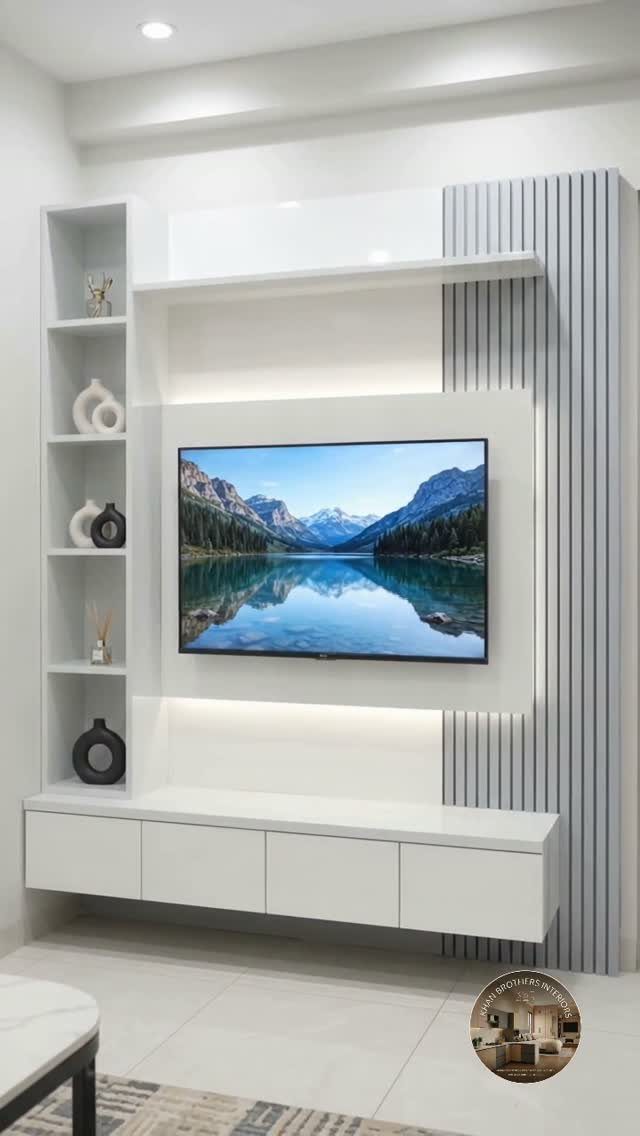
The appeal is rearrangement without a new purchase. Grid compartments let you shift open display against closed storage as your stuff changes; I started with more open shelves and added cabinet fronts when the collection grew.
The fluted panel behind adds texture without pattern that dates. Check that your wall studs line up with the mounting points, or budget for a proper rail system; modular units weigh more than they look.
I would not bother with this if you know your layout is fixed for years. For anyone who redoes a room every season, though, it pays back.
4. Curved & Sculptural TV Units
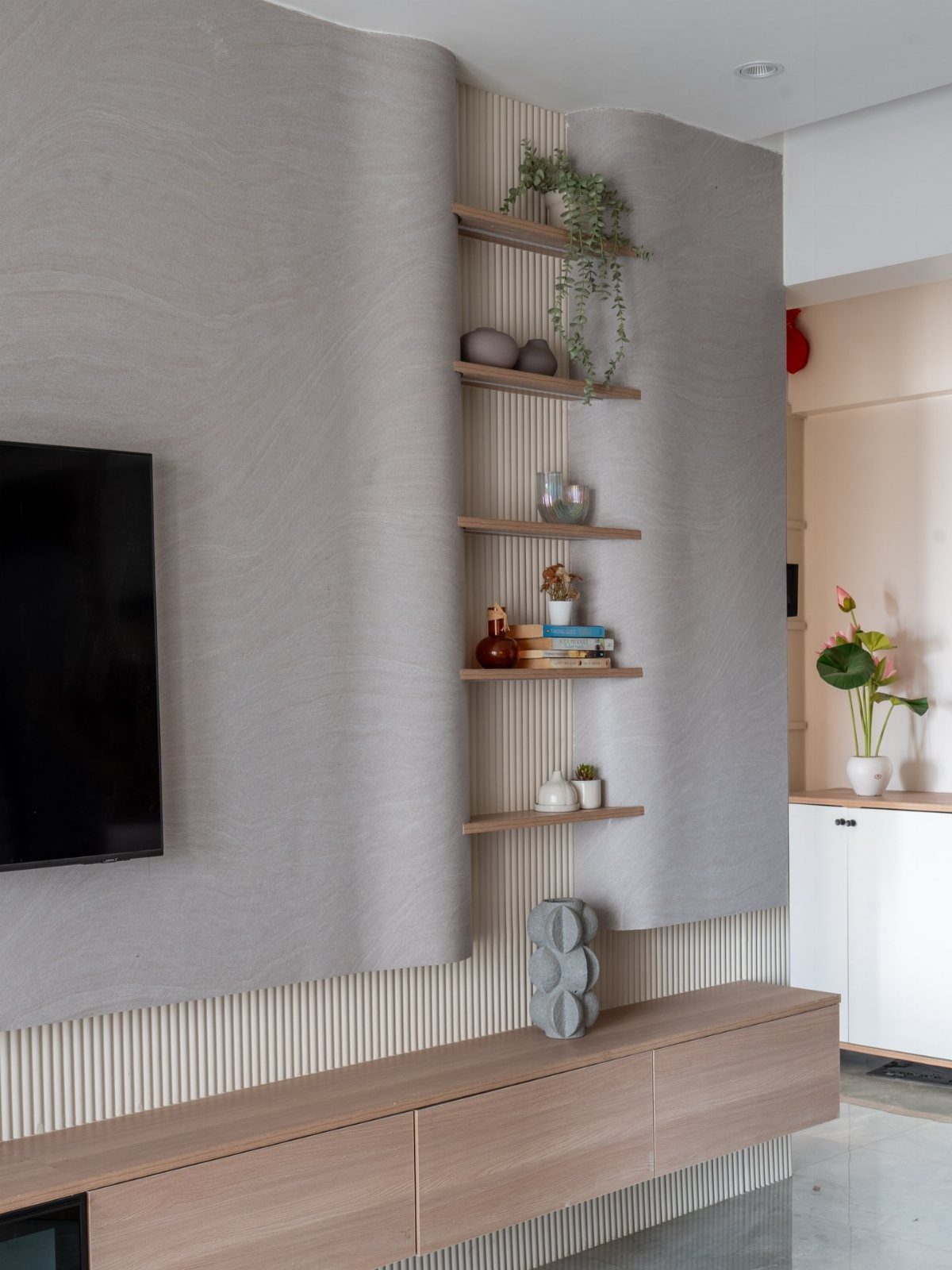
Curved panels soften a room that rectangle furniture tends to harden. A wave texture reads as movement without demanding attention; pair it with warm wood tones and the effect stays livable rather than gallery-cold.
I would keep the console simple when the wall itself carries this much shape; let one element do the talking. Installation matters more here: uneven curves show every gap, so measure thrice or hire the mounting.
Best for open-plan spaces where the TV wall is visible from multiple angles and benefits from looking finished in the round.
5. Modern TV Console with Hidden Storage
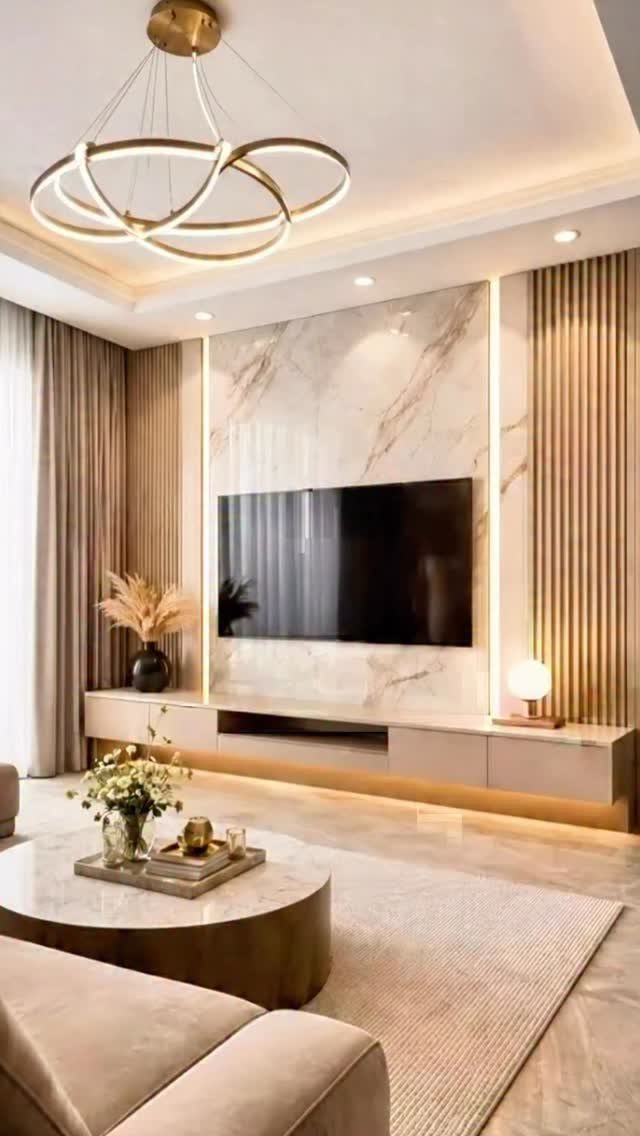
Handle-free cupboards keep the front smooth and the contents invisible. Push-latch hardware or touch-open tracks cost more than basic hinges but earn it back in the calm of the room.
I learned this after a console with visible handles became a magnet for every bag and jacket in the house. A panel above the console extends the clean line upward, though you could sub wood slats or paint for less.
Low and long consoles suit smaller rooms by staying below eye level when seated. For anyone who hosts often and lacks a coat closet nearby, this is the practical choice.
6. Scandinavian Style Minimal TV Stand Design
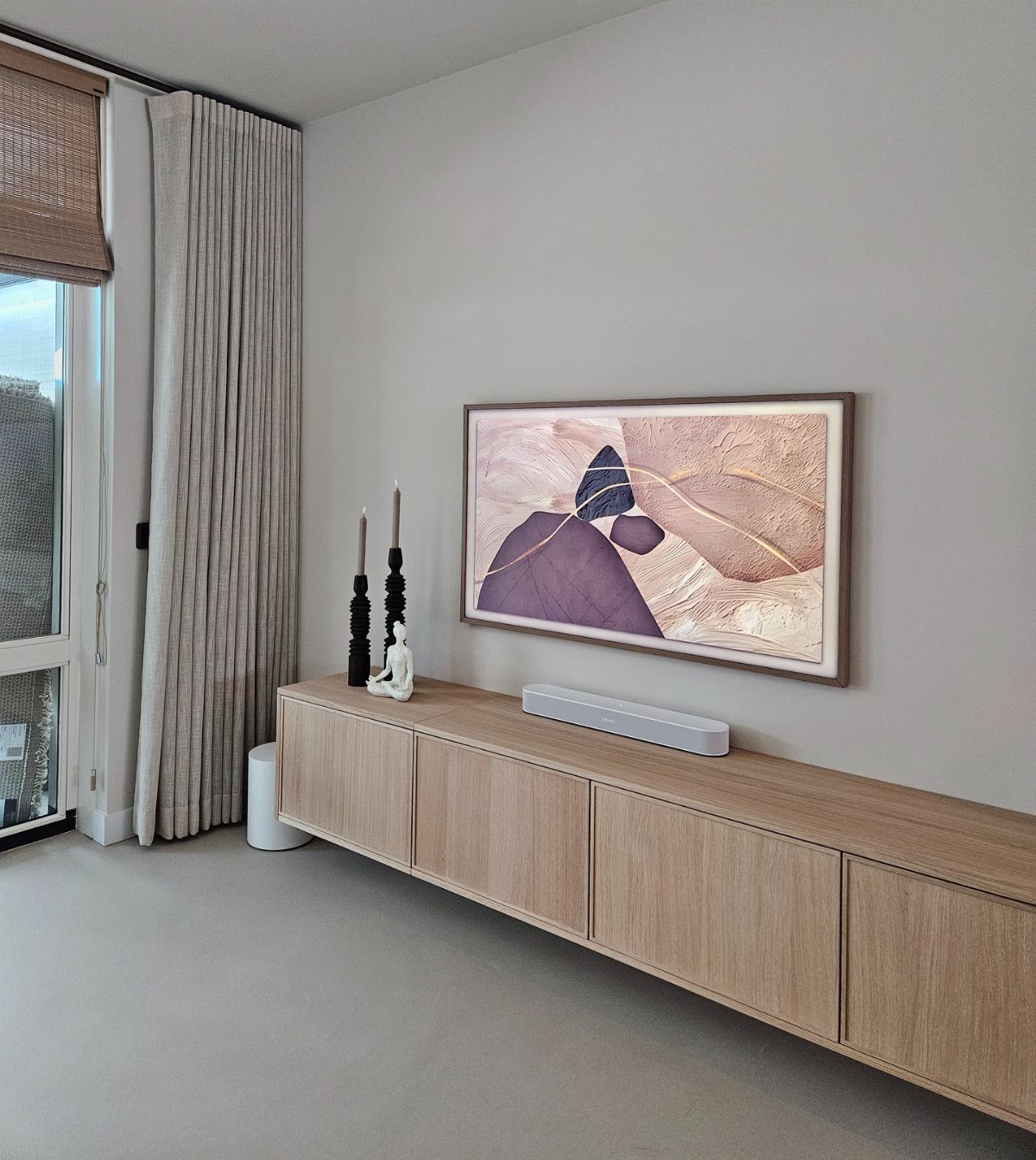
Light wood and floating mount read as warmth without weight. I added a single large piece of art above instead of shelving; the negative space is the point.
Restraint is what makes it work: one tone of wood, one accent color at most, and no small objects competing.
This style forgives cheap materials better than dark or ornate ones do; a birch-veneer console looks intentional where a dark laminate might read as budget.
Best for rooms with good natural light and for people who prefer a few beloved objects to many.

No Drill TV Wall Mount: Tired of the hassle of drilling big holes or finding studs in your wall? This Perlegear renter friendly TV mount does not require any drilling or installation experience at all. Simply use a hammer to secure the wall plate onto drywall with nails.

MODERN FLOATING TV STAND: This wall mounted entertainment center creates a clean, open entertainment wall with a sleek modern look for living rooms, bedrooms, and apartments, pairing beautifully with TVs up to 80 inches.

【Modular Design】 6 individual COB LED strips that can be used separately or combined. Perfect for display cabinets, wardrobe compartments, acoustic walls, and more. They provide uniform, soft, and glare‑free light.
7. Modern Built-In TV Wall Unit Design
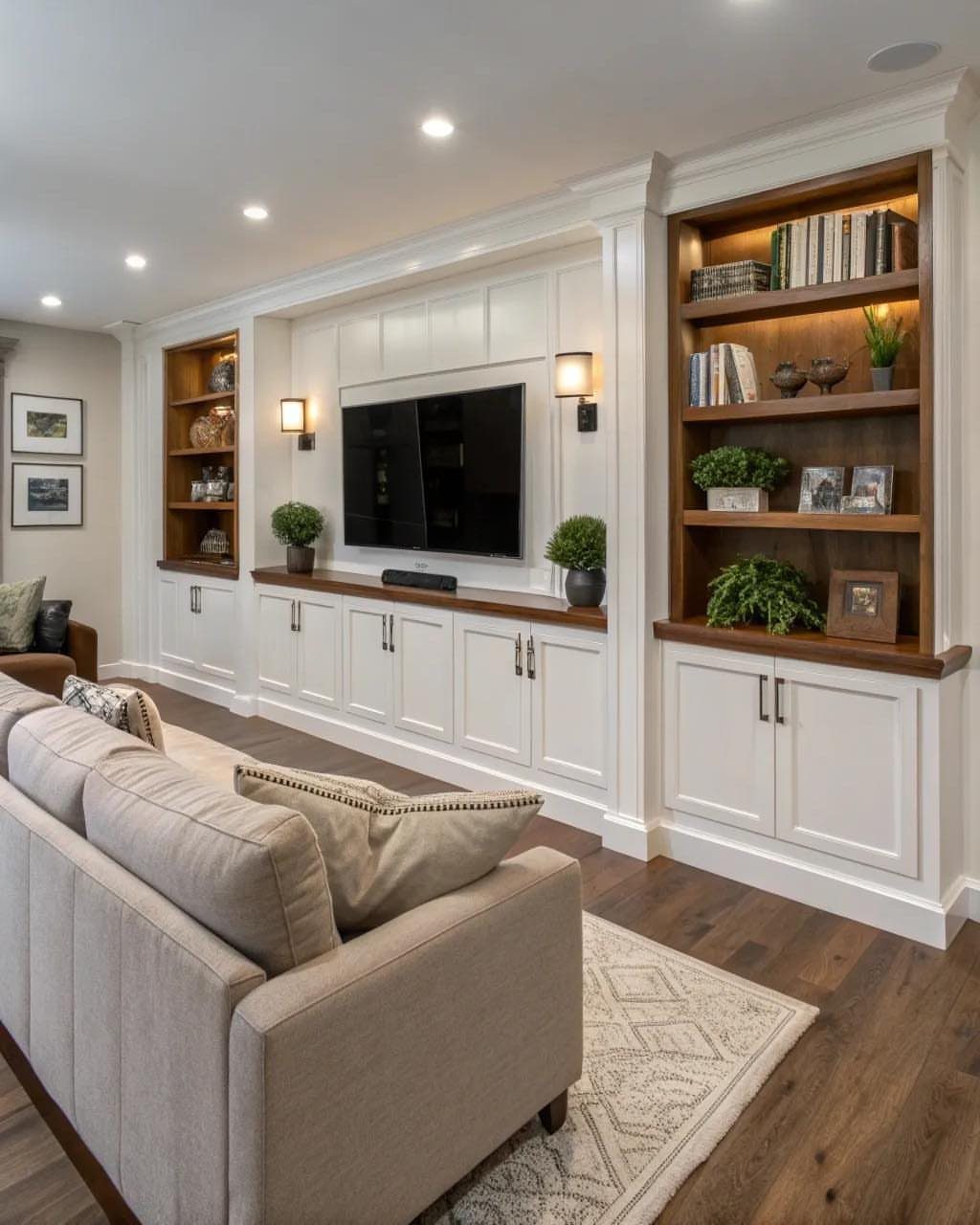
A built-in wall unit turns the whole wall into storage rather than hanging one box beneath the screen.
I like this route when the room lacks closets or the sofa sits far enough back that a full wall of shelves reads as architecture, not bulk.
A white carcass with oak shelving keeps the unit from feeling heavy; paint it to match the wall and it nearly disappears.
Premium laminate panels with an oak grain give the warmth without the weight or cost of solid timber.
Plywood construction holds up to years of loading and unloading books, though I would check that any supplier uses cabinet-grade material, not sheathing.
Sconces flanking the TV move light away from the screen and onto the things you actually want to look at.
This trades away flexibility. Once installed, the unit owns that wall.
Renters should look elsewhere; anyone who rearranges furniture quarterly will curse the commitment.

【TV LED Lights with Million Colors】KANTUTOE TV LED lights strip features a remarkable 16 million colors mood light, capable of generating various color atmospheres for different settings. Whether it's your bedroom, gaming room, or home theater, this TV LED lights can consistently create unique scenes and ambiances tailored to your preferences.
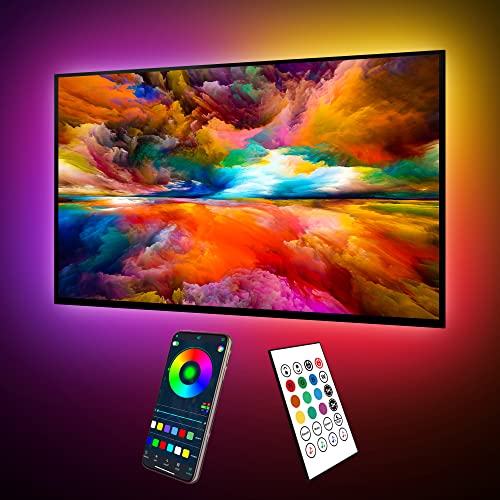
Upgraded ICRGB TV Backlight Effects: Maylit ICRGB TV lights can display multiple colors on a line at a time, compared with traditional RGB TV lights. More vibrant and dynamic to light up the TV, improve your TV watching experience.

【TV LED Backlight with Music Sync】KANTUTOE's TV LED Backlight features over 20 dynamic modes and 16 million color variations. Press the music button on the remote control or app to activate the TV LED light's built-in high-sensitivity microphone, which captures real-time music and ambient sound intensity. The light strip displays different colors and rhythms that are synchronized with the music.
8. Simple Wall-Mounted TV Cabinet Design
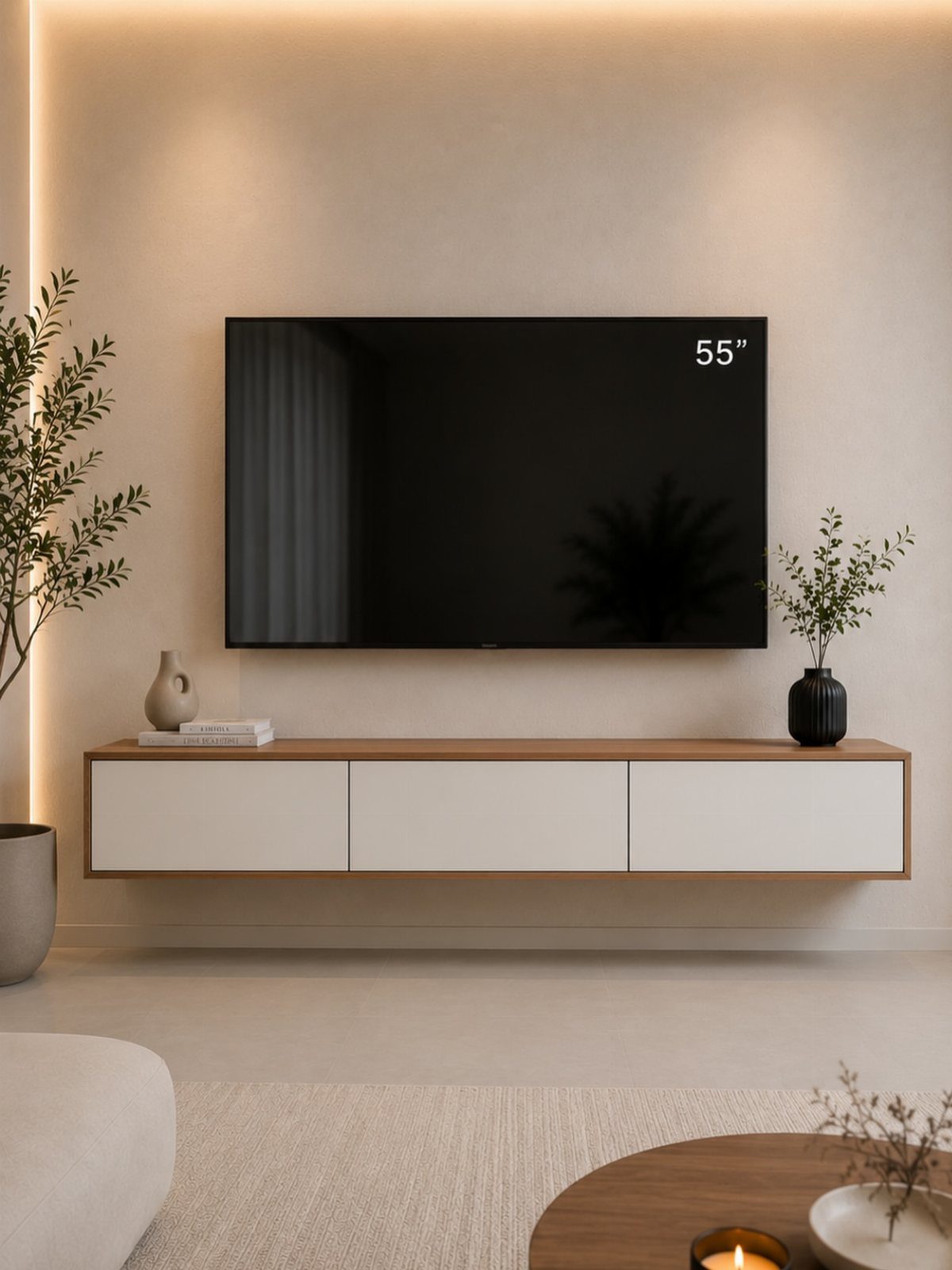
Floating cabinets buy back floor space in small living rooms, and the gap beneath makes a tight room feel less boxed in.
The white-and-wood version reads as two simple planes: a rectangle of cabinet, a rectangle of screen, nothing else fighting for attention.
Light wood or pastel laminates bounce more light around than dark finishes, which matters when the only window faces the neighbor’s brick wall.
Mount the cabinet high enough to keep the floating effect, low enough that you are not kneeling for the remote.
Warm cove lighting is easier to wire during construction than retrofit, but battery LED strips tucked behind work as a weekend fix.
For renters who cannot run cables through drywall, a cord cover painted to match the wall keeps the look clean. Storage volume is the cost: one long shallow drawer fits cables and a soundbar, not much more.

1.Material : Vinyl Cloth, Non Splice, Seamless, Using iron to remove the crease.

Tabletop Flatlay: Photography: Designed for blogger, online seller, professional photographer, hobbyist taking amazing photo. Ideal for commercial advertisements, restaurants, bakery, books, magazines, ins daily record.
9. Minimal TV Unit with Open Shelves
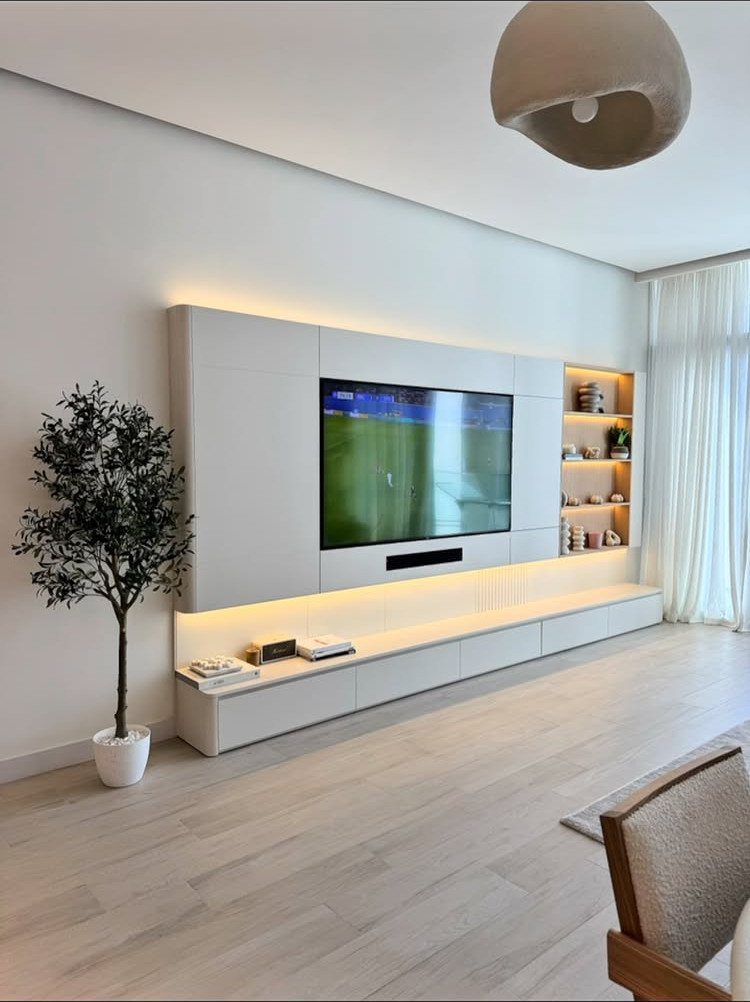
Open shelving beside the screen gives a place for the objects that make a room feel inhabited without the visual weight of a full wall unit.
Shelves kept to the right only stop the wall from reading as a shrine to the television; I prefer this to symmetrical arrangements.
Ambient cove lighting, visible as a soft glow above the shelves, needs a recess or a false ceiling to hide the source.
If your wall is flat plaster, skip it rather than build out the whole surface; a slim picture light above the TV gives a similar effect for less labor.
Sandy Fossil Recon laminate, with its muted warm tone, handles the daily dust better than pure white.
This suits someone with a curated collection, not someone with a curated mess. The shelves demand editing; if you are the type who stacks mail there, cabinet doors serve you better.
10. Low-Height Minimal TV Console
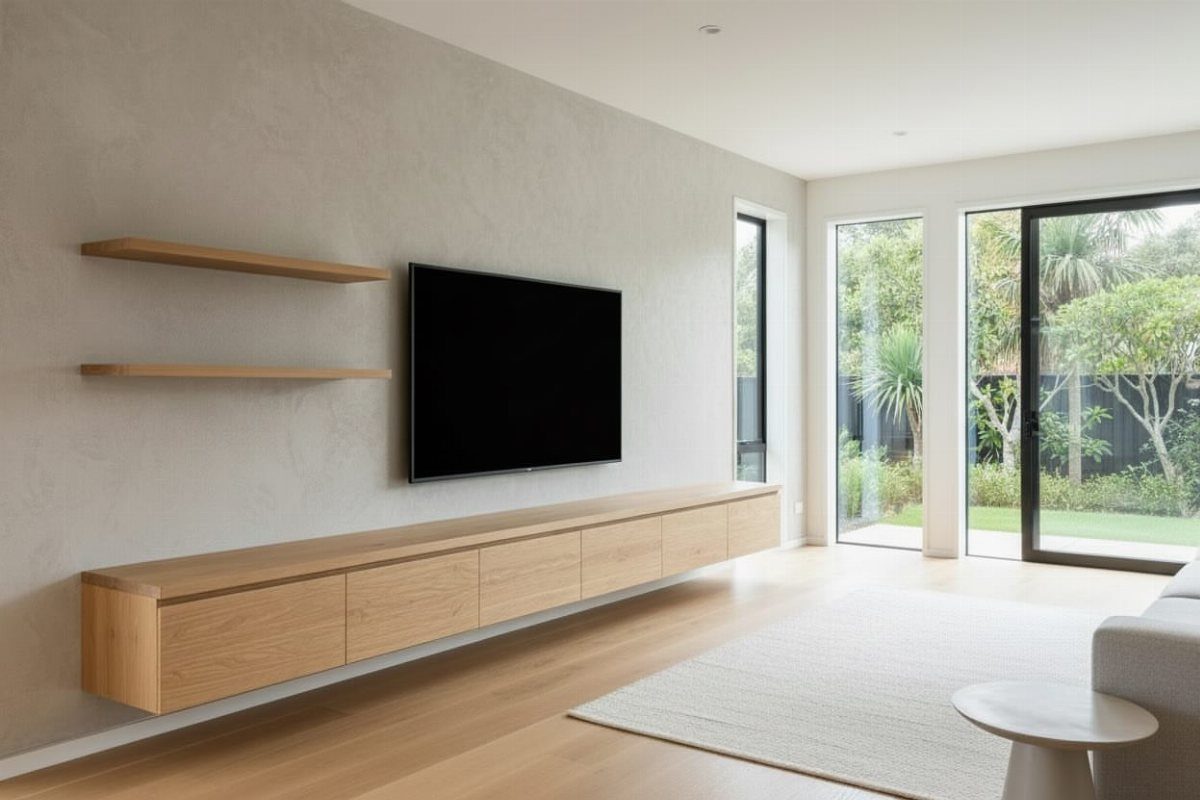
Low consoles change how you use the room. A low height invites floor cushions or a low sofa, a setup that works beautifully in spaces that double as yoga corners or children’s play areas during the day.
The two floating shelves flanking the screen carry the horizontal line upward without breaking the low gesture. I would keep them at the same depth as the console or shallower; deeper shelves stack visual weight where you want air.
Hardwood veneer over plywood construction holds up to the occasional knee or toy truck, though I would edge-band the exposed ends to prevent splintering.
This is poor for traditional seating. A standard seat height leaves your ankles crossed awkwardly above the floor.
Measure your existing furniture before committing, or plan to replace it.
11. Wooden Slat TV Back Wall Design
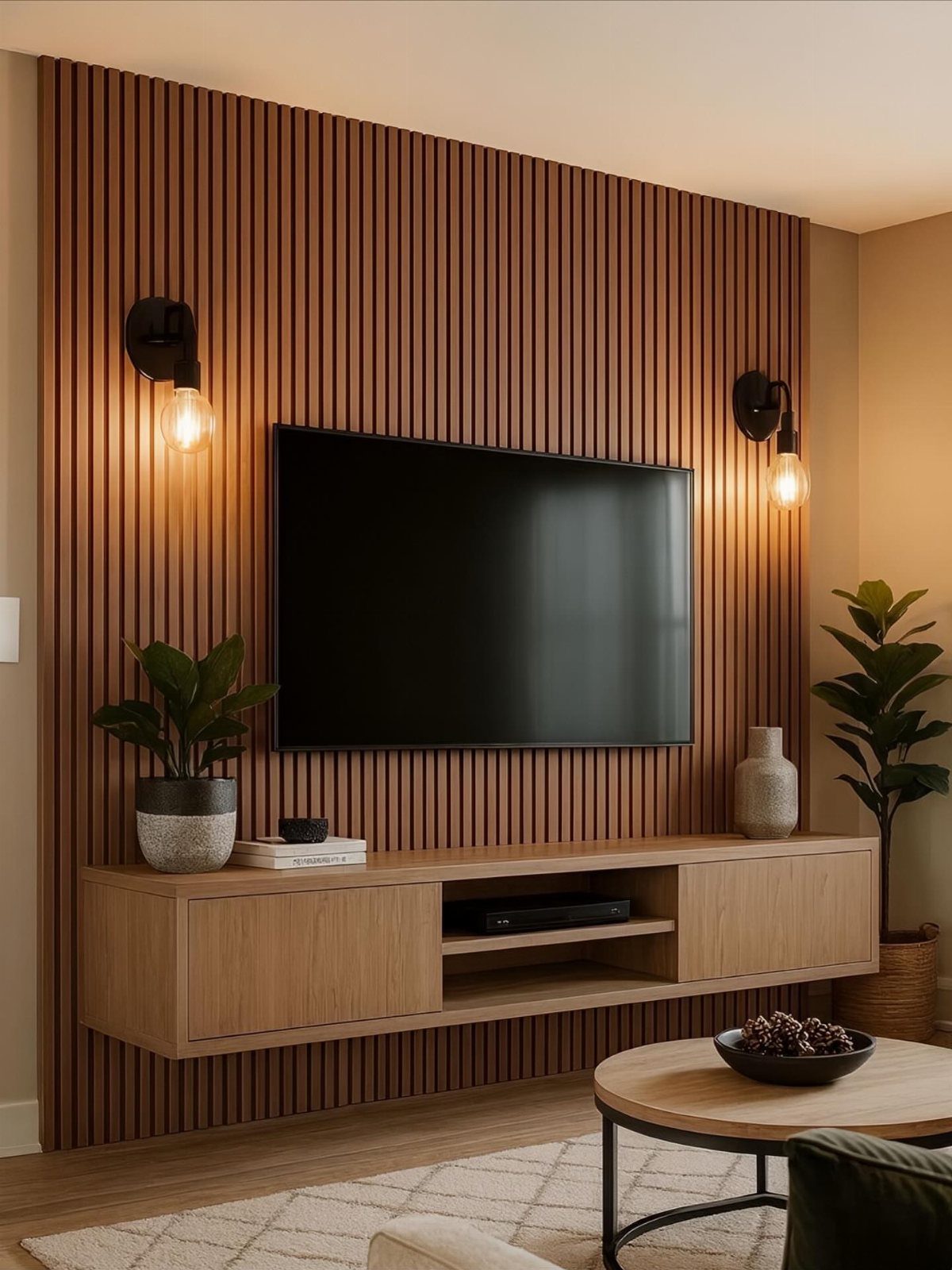
Vertical slats add rhythm and shadow to a wall that would otherwise read as flat paint behind a black rectangle.
Warm wood brings in the one material that almost everyone agrees on; I have yet to meet a renter or owner who actively dislikes oak slats.
Installation runs easier than it looks. Slat panels mount as a unit on furring strips, with the gaps between boards already routed.
The floating console below clears the slats rather than butting into them, which simplifies the carpentry.
Sound absorption is a real side benefit in hard-surfaced rooms; I notice the difference most in apartments with concrete or tile floors where every conversation echoes.
Dark stains read more dramatic, light stains more Scandinavian. Sconces are optional but effective; without them, the slats alone can feel like unfinished business.
12. Modern TV Wall Design with Paint Accent
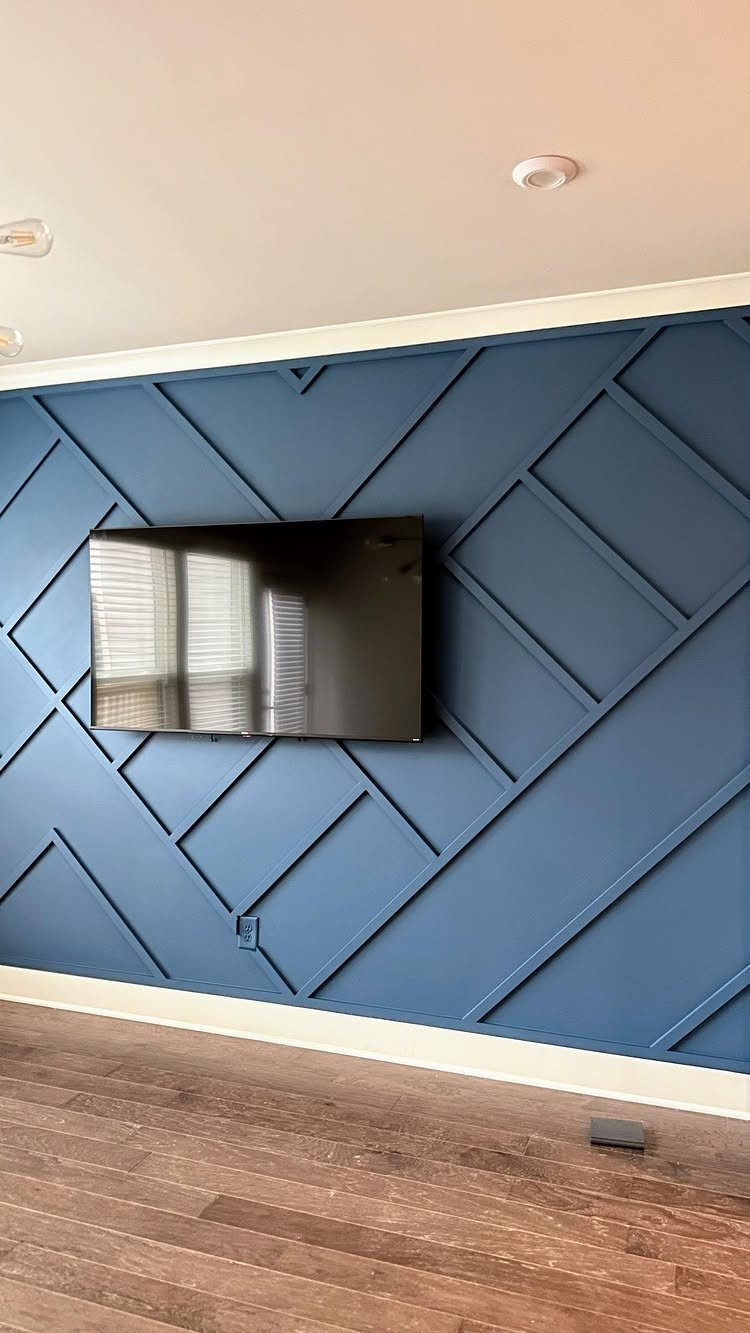
Paint with molding gives you a textured wall without the cost of tile, stone, or laminate.
Deep blue with geometric wood slats reads as intentional geometry rather than applied decoration, because the pattern continues behind and around the screen rather than framing it like a picture.
Raised slats on a painted wall need precise spacing or the pattern turns busy. I would lay it out on the floor first, photograph the arrangement, then transfer measurements to the wall.
Metallic accents, brass in particular, warm up cool paint colors; a slim brass rod at one or two junction points in the pattern would pick up the tone without announcing itself.
This demands patience and a level. Diagonals particularly punish sloppiness; one off-angle slat throws the whole rhythm.
Beginners might start with a simpler grid, all horizontals and verticals, and still get most of the effect.
13. Decorative PVC TV Background Panel
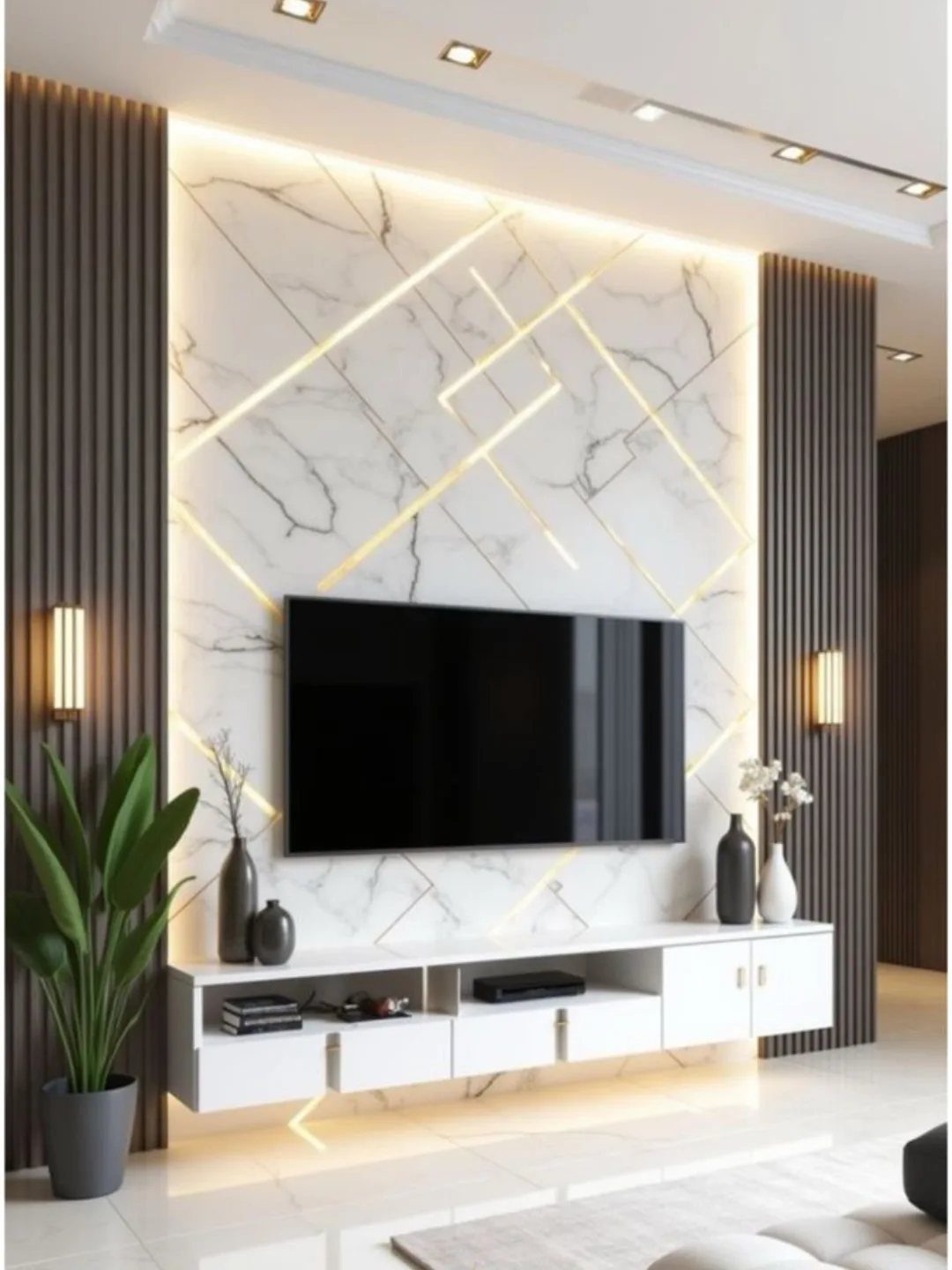
A PVC background panel lets you fake stone, marble, or geometric patterns for a fraction of the weight and cost of the real thing.
I like this route for renters or anyone who wants the look without committing to masonry. The panels come in 4×8 foot sheets, light enough for one person to lift, and you can cut them with a circular saw.
Mount them straight to the wall with construction adhesive and a few screws into studs. The geometric LED strips run behind a recessed lip; leave a gap between panel edges for the light to escape.
What changes the answer is your wall condition. Uneven drywall telegraph through thin PVC, so check for flatness first or add a layer of plywood behind.
Ventilation matters too; heat builds up around enclosed TVs, and a floating console with open sides helps air move.
Best for: quick impact on a Saturday, especially when the wall behind your TV is currently a blank eyesore.
14. Stone Finish TV Background Wall
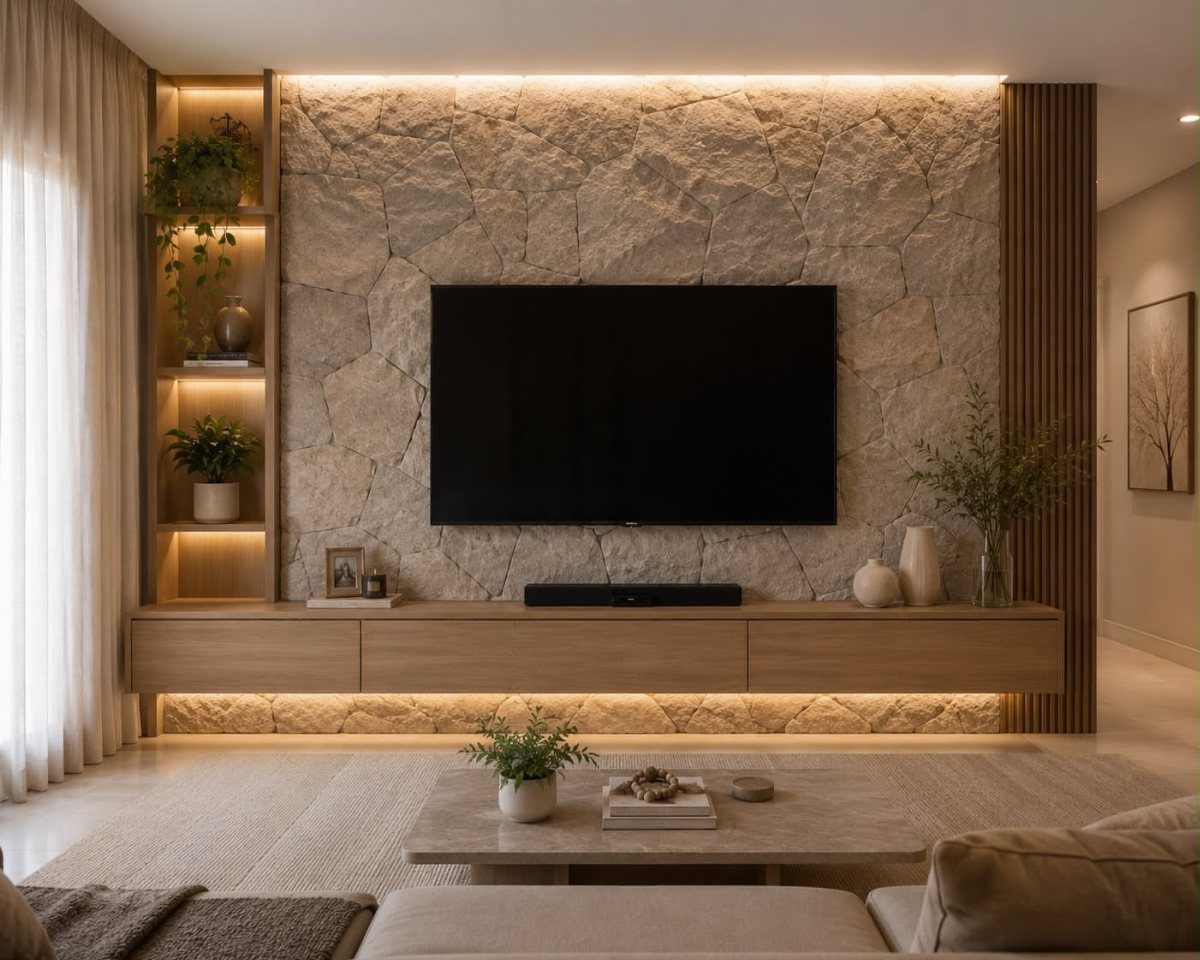
Real stone weighs too much for most residential walls and costs more than this reader’s budget. A stone-finish laminate or textured wallpaper gives the same depth without the structural headache.
Textured stone finish reads richer with backlighting that washes up from behind a floating console. That glow is doing more work than the stone itself; skip the lights and the wall goes flat and cave-like.
I would run LED strip channels along the back edge of any console or shelving before worrying about which stone pattern to pick.
Laminates with embedded granules catch light like real rough stone and wipe clean with a damp cloth. Actual stone veneer needs sealing and still stains.
For a weekend project, the laminate wins every time.
Tradeoff: close up, the repeat pattern betrays itself. Stand back and the effect holds.
15. Main Hall Modern TV Unit Design
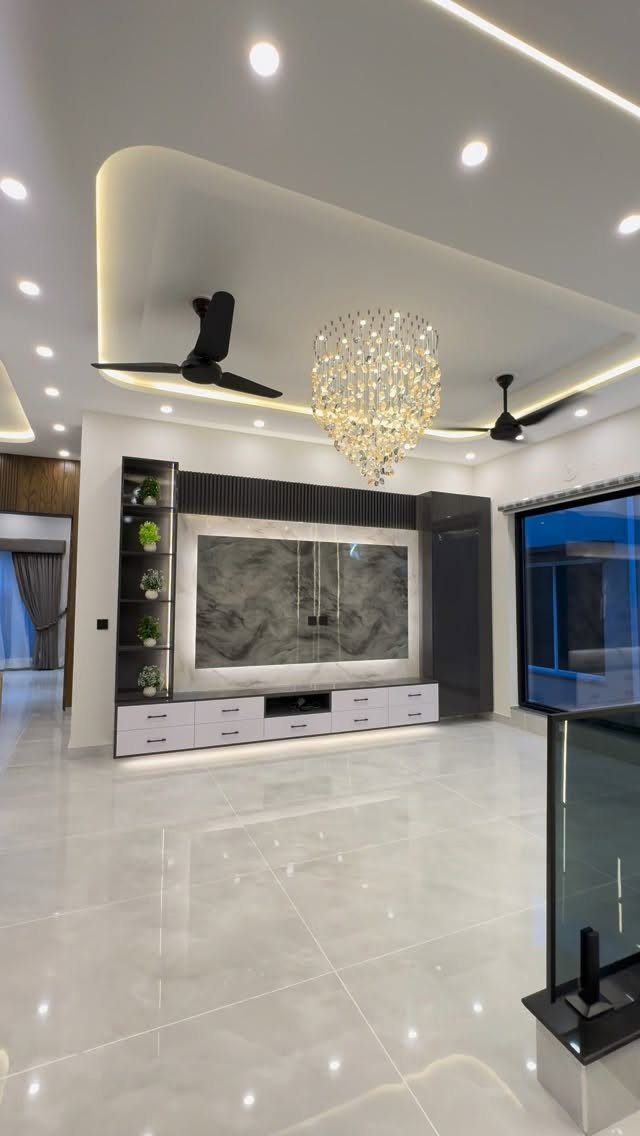
The main hall is where guests land first, so the TV unit ends up doing double duty as a room’s second impression after the seating.
What makes it work as "main hall" rather than "basement den" is the vertical rhythm: the shelving and paneling draw the eye up, making the ceiling feel higher. A squat, wide unit would shrink the room.
For a cohesive look, match the laminate’s undertone to your flooring. The grey and white here talks to the marble floor; a warm wood floor would fight it.
Cable management built into the console keeps the chandelier and recessed lights from competing with black cords.
This much built-in storage suits households that need to hide remotes, gaming gear, and the router in one cabinet.
If your hall is a pass-through space, not a destination, scale down to a single panel and console so traffic flows around it.
16. Drawing Room TV Panel
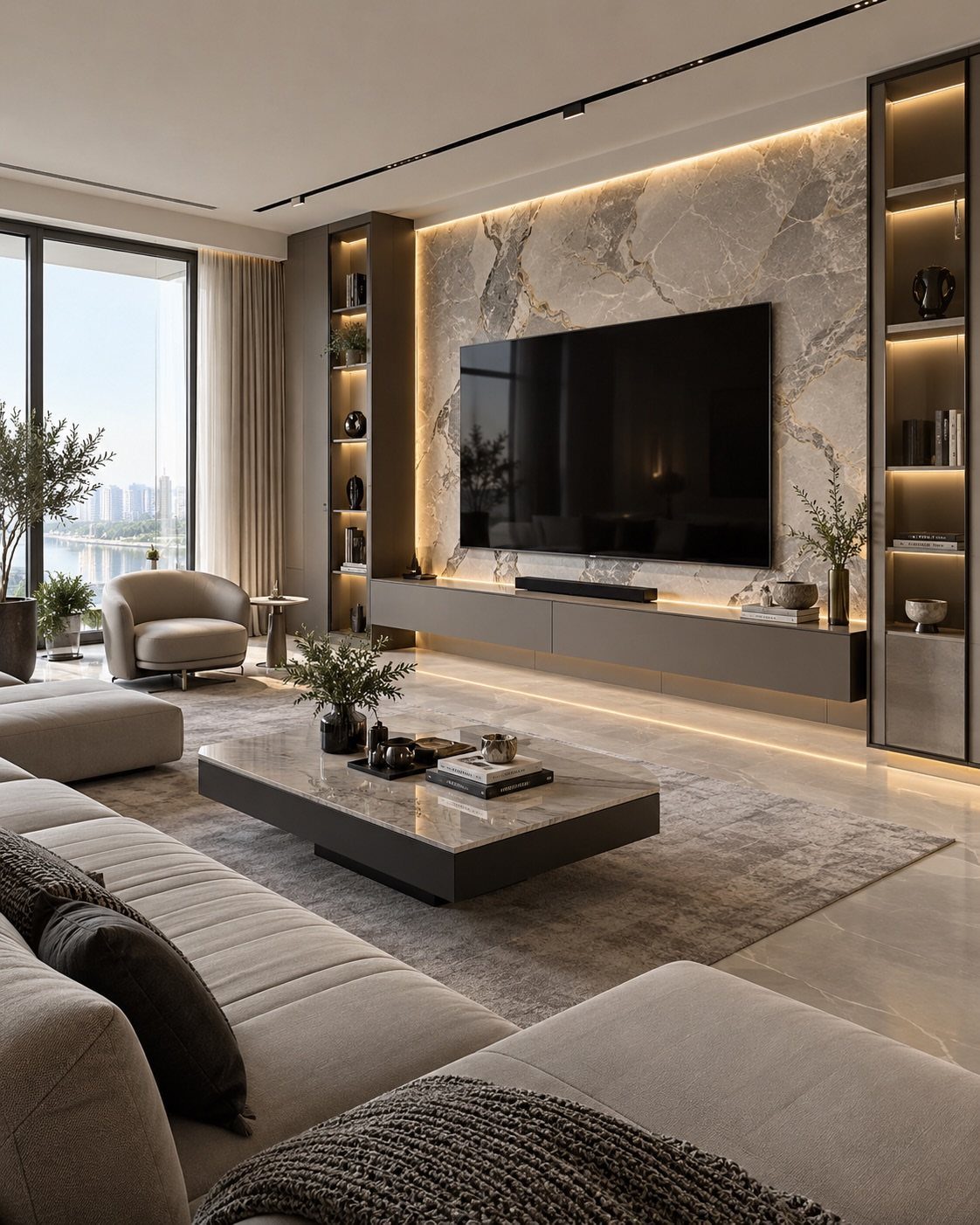
Drawing room is just another name for the living room you show off, but the word signals intent: this is the wall you face when seated, not the one you glance at from the kitchen.
The photo’s marble panel with cove lighting and flanking shelves creates a frame for the TV without a frame. The low grey console disappears visually, letting the wall itself read as the feature.
Height matters here; the stand should run wider than the TV, and the center of the screen should hit at seated eye level.
For city views like the one visible past the sofa, keep the wall treatment lighter than the window frame so the eye travels outward, not stopping at the TV. Dark built-ins would have killed that depth.
17. Marble TV Unit Design for Luxury Spaces
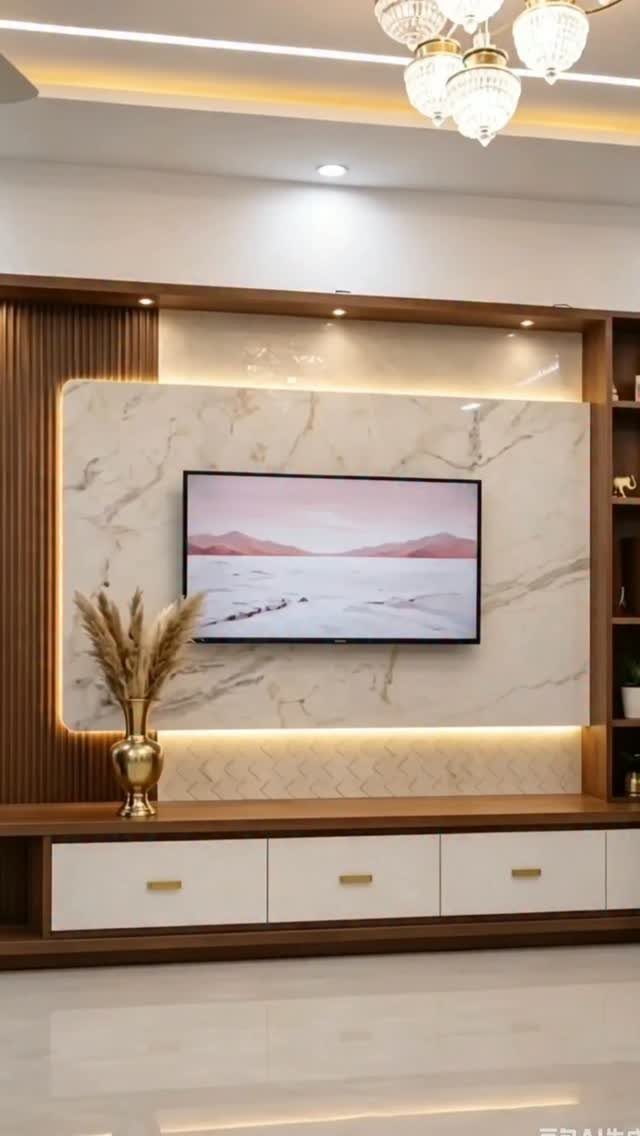
Marble laminates have reached the point where I cannot tell the difference up close, and I have spent too many Saturdays in tile showrooms.
A scratch-resistant satin finish matters more than it sounds. Glossy marble-look surfaces show every fingerprint and dust streak; satin forgives daily life.
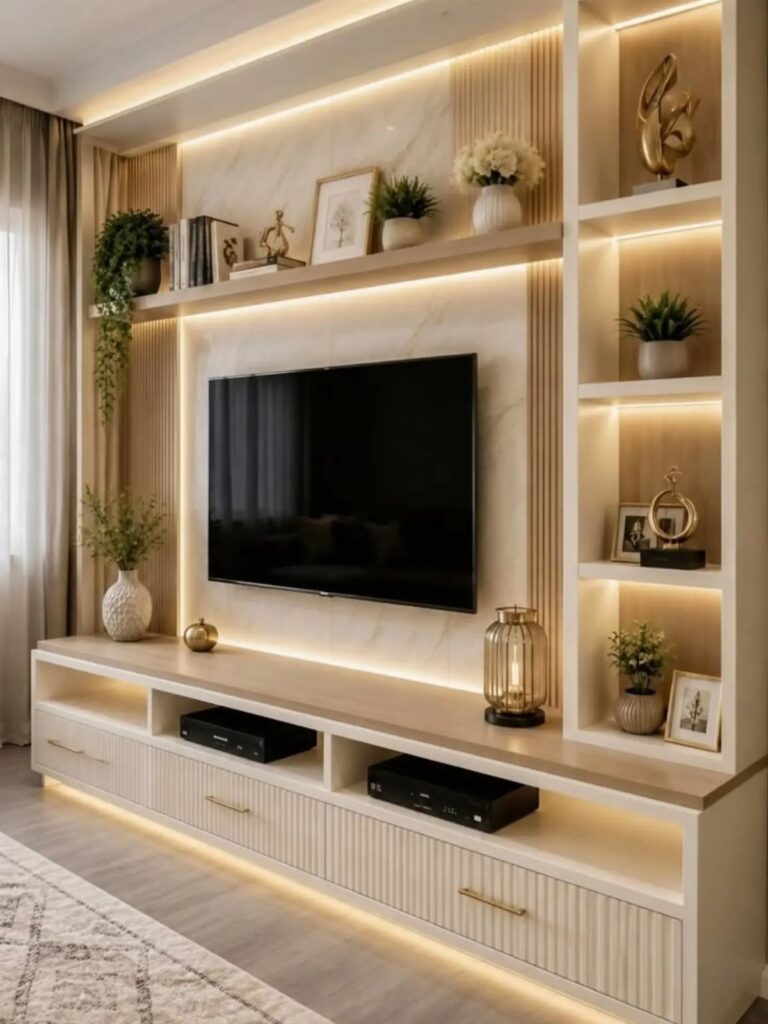
Fluted wood panels flanking the TV add warmth that pure marble would lack, and LED backlighting reads as ambient light rather than gadgetry.
Real marble runs high per square foot installed. Laminates run a fraction of that and install with contact cement and a router for edges.
The premium lines with embellished granules catch light almost like veining.
Who this suits: anyone who wants the luxury signal without the luxury maintenance budget. Who it does not: purists who will touch the wall to check.
18. Full Wall Entertainment Unit with Shelves and Cupboards
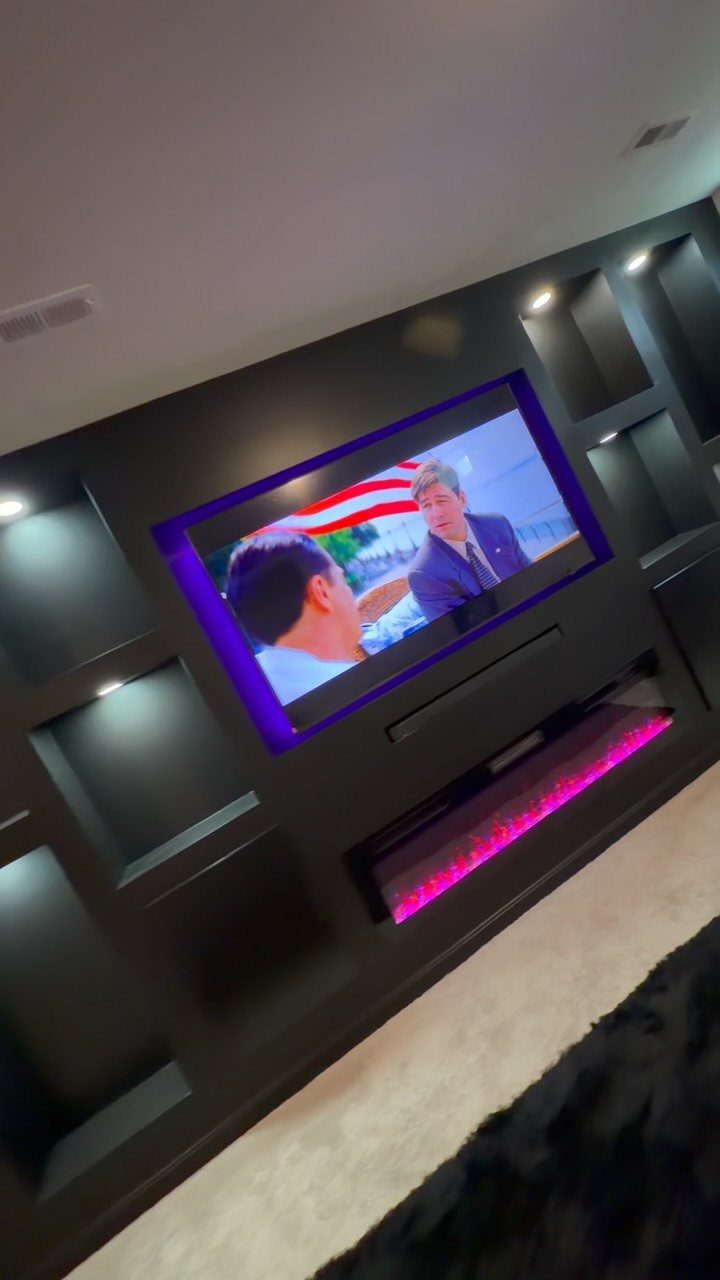
A full-wall unit turns the TV from a screen on a wall into an architectural element, but only if the wall is wide enough to breathe.
The photo’s black built-in runs the full width with the TV centered, flanked by open shelving with integrated downlighting, and a long horizontal compartment below glowing pink.
That color shift is doing mood-setting work; without it, the black mass would feel like a void. I would wire the shelf lights and the horizontal glow on separate dimmers so you can run one without the other.
Closed cupboards at the base hide the cable nest and gaming consoles; open shelves above display what you want seen.
For a high-end private cinema feel, use darker wall colors outside the unit so the lit shelves pop. In a bright white room, the effect diffuses and dies.
Time commitment: this is not a weekend. Plan for a contractor or a very patient helper and 2–3 weekends minimum.
19. TV Unit with Wallpaper Back Panel
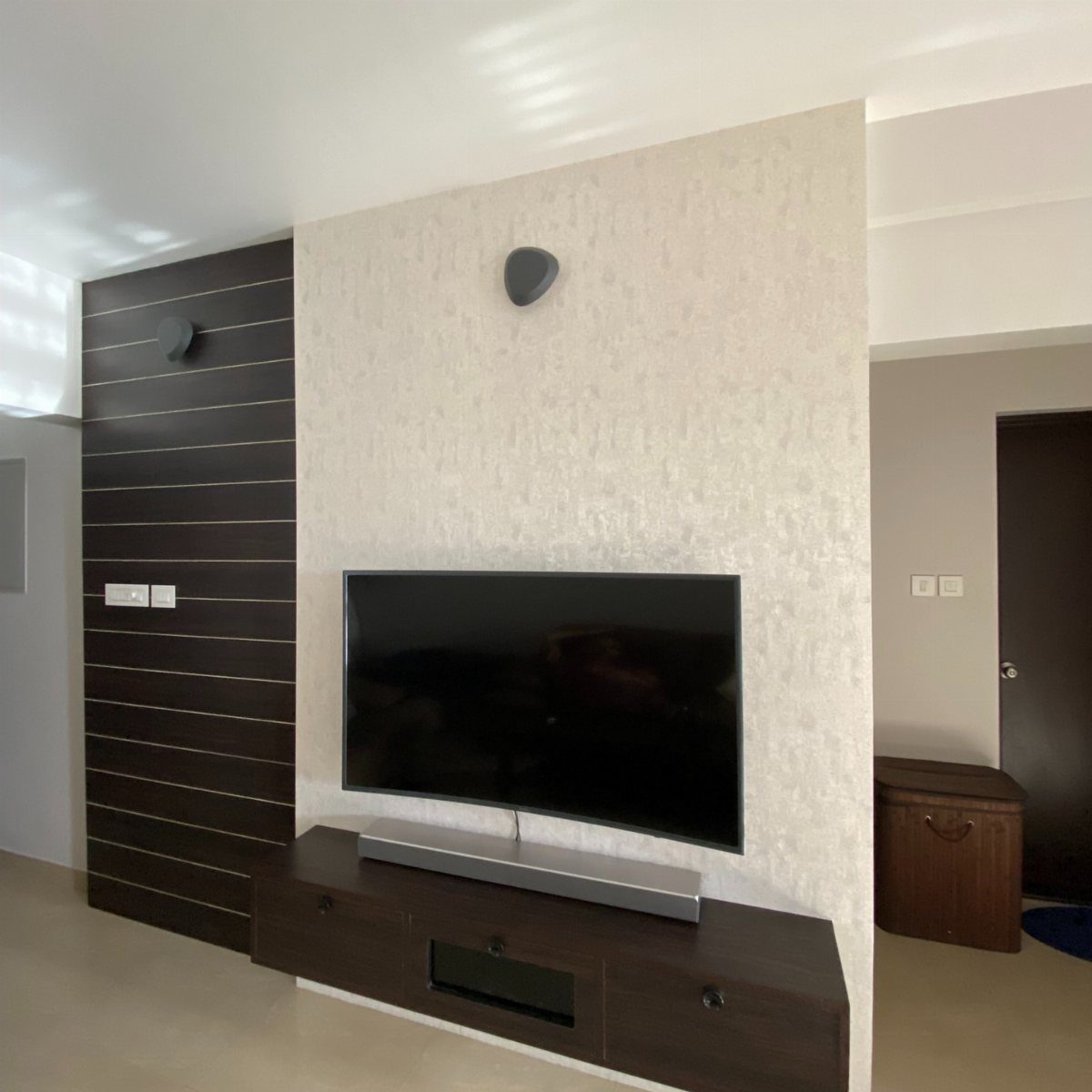
Wallpaper behind a TV sounds like a risk until you see it done right. Treating the panel as one framed field, not a whole wall, lets the pattern stop before it overwhelms the room.
Geometrics read more modern than florals here; paisley can tip toward dated fast. I’d pick a textured weave or subtle repeat for a small living room where the TV already commands attention.
Cost stays reasonable since you’re papering a contained panel, not a full wall. Paste-the-wall varieties go up fast, and removable options mean you can swap it when the mood shifts.
20. White Fluted TV Wall Panel
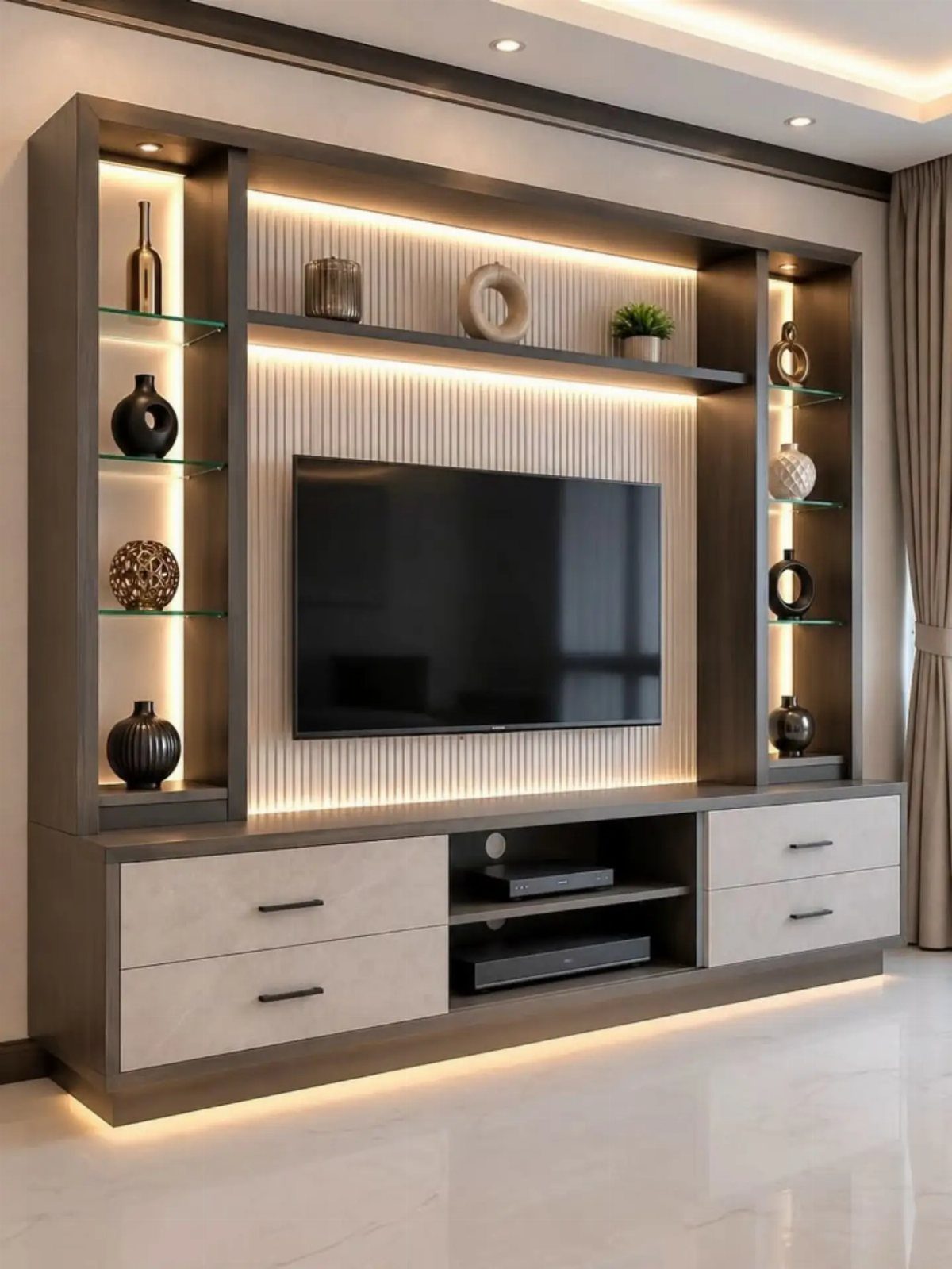
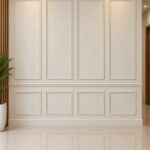
Vertical ridges catch light differently than a flat surface, which is why fluted paneling reads as intentional rather than unfinished. White keeps the effect quiet enough for a built-in that also holds shelves, drawers, and display space.
The panels run behind the TV only, not across the whole wall, so the texture defines a zone without turning the room into a showroom.
Warm LED strips tucked into the top rail graze the ridges and cast soft shadows that move as you walk past.
Paint-grade MDF works for this if you’re building from scratch; pre-made fluted boards save a weekend. Either way, matte white paint hides seams better than gloss.
Dark wood frames and hardware keep it from feeling too sterile.
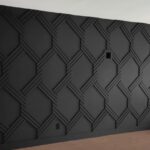
21. Dark Ribbed TV Wall Panel
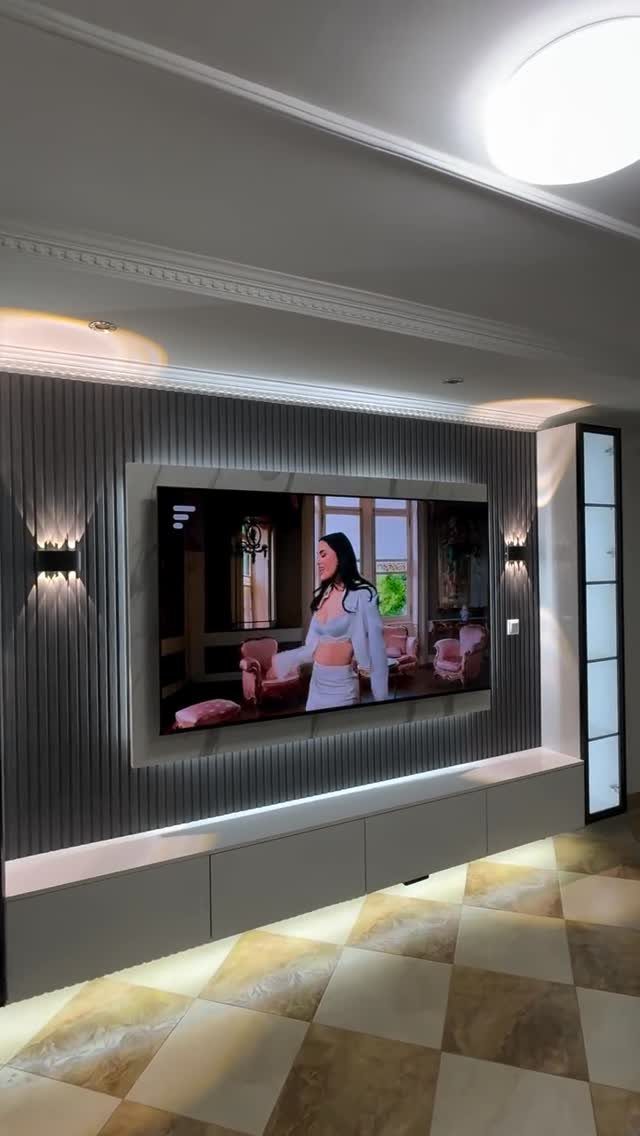
Dark vertical ribs do the opposite of white fluting: they absorb light and push the TV forward as the single bright rectangle in a dim field.
The effect is cinematic, which suits a room where you actually watch movies rather than leave the set on for company.
A white console below breaks up the darkness so the wall doesn’t close in. Light wood or pale tile gives most renters the same contrast without committing to a bold floor.
The ribbed panel itself is usually MDF with a routed pattern or applied strips, painted in a deep charcoal or soft black.
Satin finish picks up just enough ambient light to show the texture without glare bouncing back at the screen.
Small rooms gain depth from this; very dark spaces can feel like a cave.
22. TV Wall Panel with Integrated Fireplace
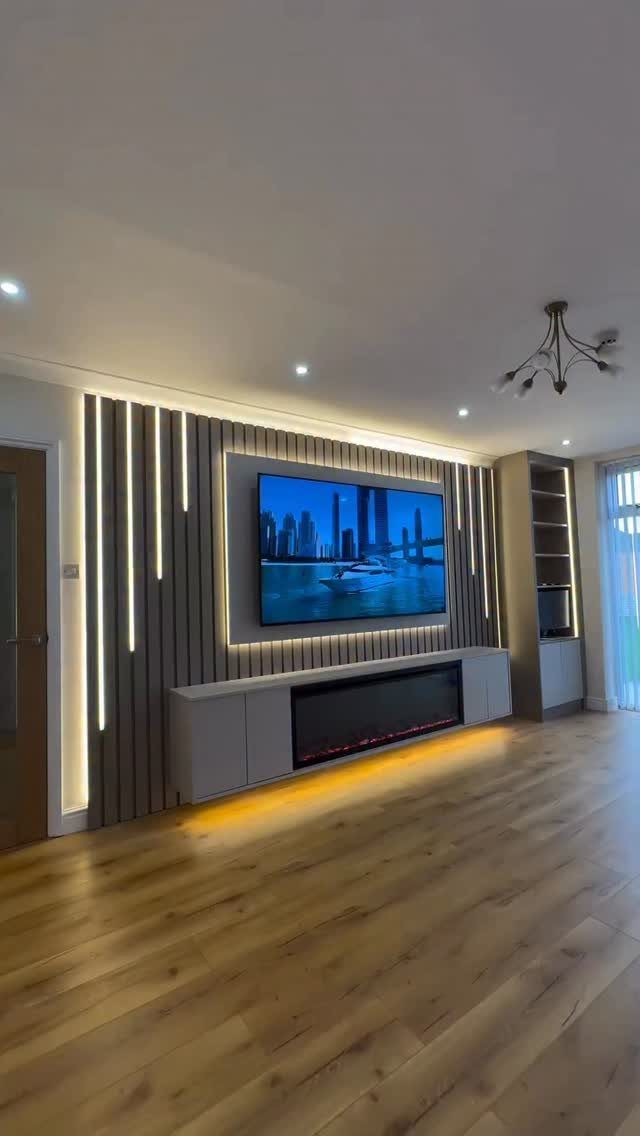
An electric fireplace below the TV solves a layout problem I have hit in every apartment with a long living room: one focal point or two, never enough wall for both.
Stacking them centers the seating and gives the eye somewhere to rest below the screen.
The fireplace in these photos is linear and low, more glow than flame, which keeps the heat away from electronics.
Plan for a dedicated circuit if you’re building this; most units pull enough wattage to trip a shared breaker. Storage cabinets flanking the fireplace hide cables and components that would otherwise clutter the console.
This is the most expensive idea on the list, but it is the one that makes a rental feel like a finished house.
23. Bold Color TV Wall Unit
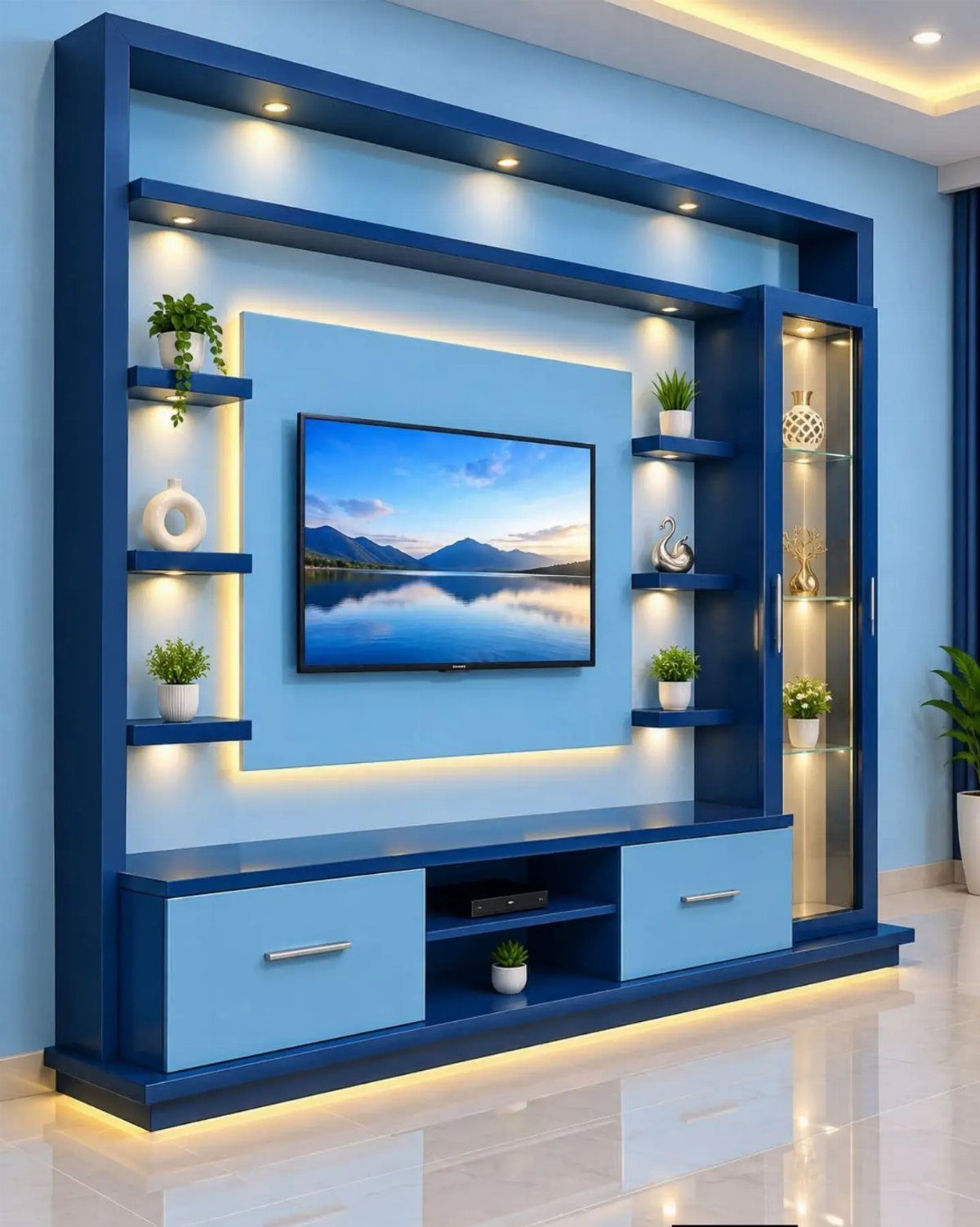
A blue this saturated on a wall unit is a commitment, which is exactly why it works in a room that otherwise plays safe with beige walls and standard trim.
The light and dark panels break the mass so the unit reads as furniture, not architecture.
Integrated lighting matters more here than in neutral units; without it, the color can flatten to a blob after dark. Glass cabinets on one side give the eye a resting place from all that pigment.
This suits someone who knows their taste and does not mind the unit dictating the room’s palette for years. If you repaint walls often, stick to a white or wood case and get your color from art that moves.
24. Wavy 3D Textured TV Panel
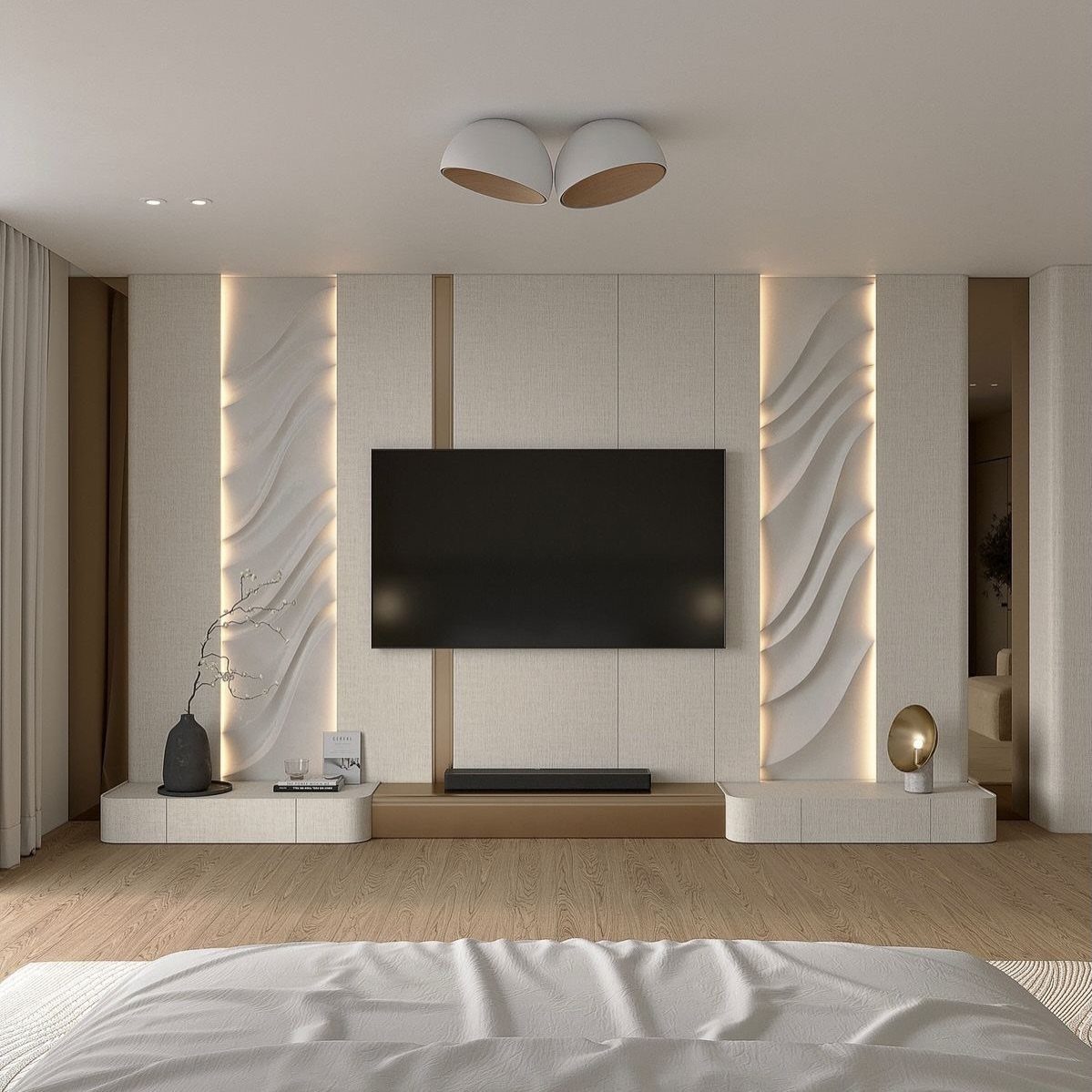
Wavy 3D panels look handmade in a way flat boards cannot, which is their whole point. The undulations catch backlighting at different angles, so the wall changes slightly as you shift on the sofa.
These panels install like tile, in squares that lock or butt together. The beige version keeps the texture visible without demanding attention; painted versions lose the shadow play that makes the waves read.
A low console below is non-negotiable, anything taller would fight the vertical rhythm. The LED strips need a channel routed behind the panel, so this is a plan-ahead detail, not a weekend add-on.
I would reserve this for a bedroom or a formal living room where the TV stays off for long stretches; the texture deserves to be seen on its own.
25. Circular Backlit Feature Panel
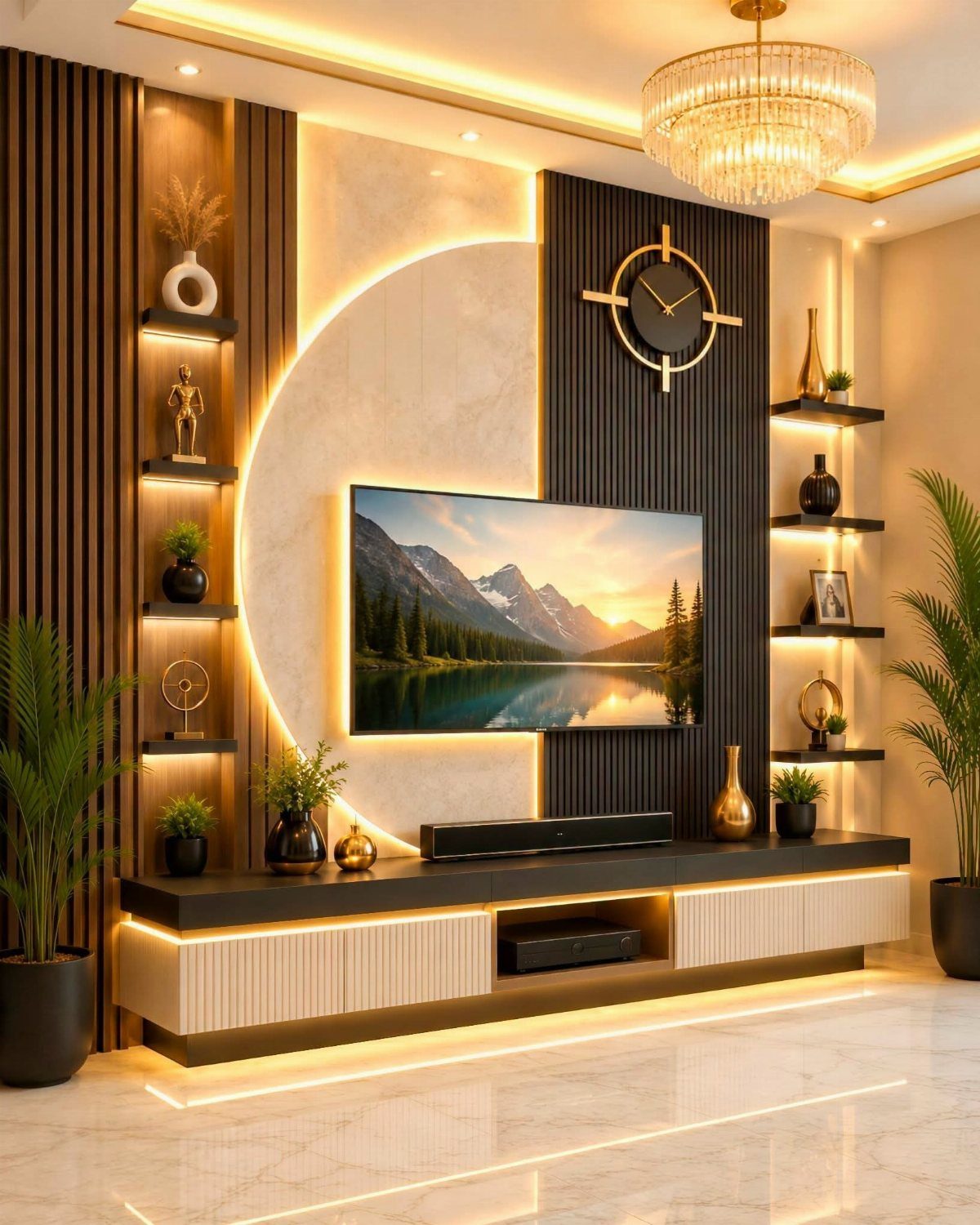
A backlit circle turns the TV wall into something closer to art than furniture.
The light behind the panel does the heavy lifting; the TV almost reads as an afterthought, which is the point in a room where you want the architecture to lead.
LED strips run behind a circular cutout or mounted panel, and a dimmer lets you match the glow to the hour.
I would keep the circle in a warm white or a tone that reads against the wall; color-shifting strips look like a dorm room fast. The rest of the wall stays quiet: vertical slats, a low console, no competing glow.
This one trades storage for presence. If you need to hide cables, a box, and a game console, the circle itself does not help; build that into the console below.
26. Flanked Glass Display Cabinet Unit
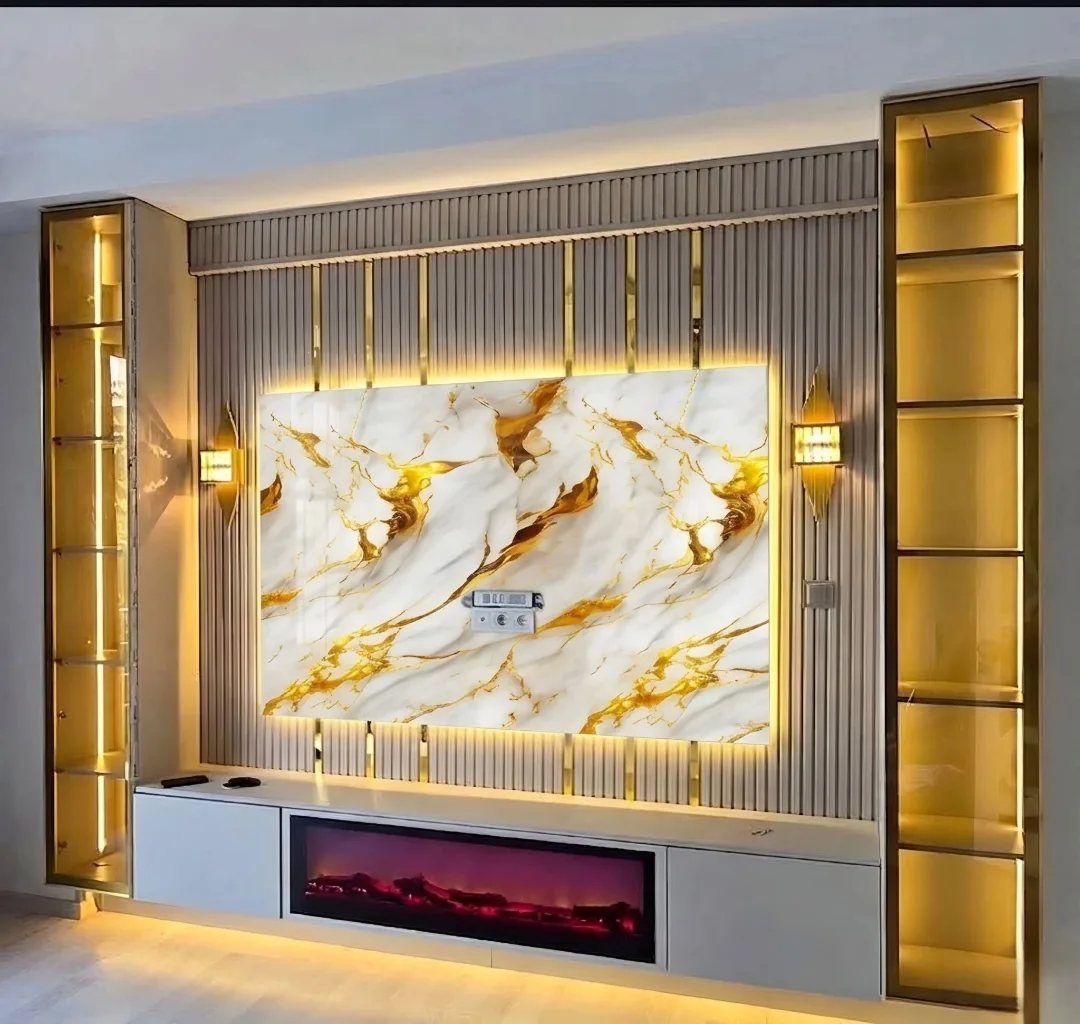
Glass cabinets on both sides of the TV turn the wall into a display you already own.
Trophies, pottery, a stack of books you actually like looking at: the contents become the decoration, and the TV sits as the center anchor rather than the whole story.
Warm cabinet lighting matters more than the fixture choice. I would skip cool white LEDs; they make glass feel like a jewelry case and wood feel cheap.
The vertical slats or fluted panels between the cabinets and the TV give the wall its rhythm, so get those aligned before the cabinets go in.
The trade is dusting and curation. Empty cabinets read as failure; cluttered ones read as hoarding.
This suits someone who already collects and rotates, not someone who wants the wall finished and forgotten.
Best Materials for TV Units
I would pay the small premium for marine-grade or termite-treated ply if your climate runs humid; standard plywood swells at the edges eventually.
High-density moisture-resistant board outperforms both plywood and MDF in bathrooms or coastal apartments where moisture finds every seam. Its screw holding is the hidden benefit: hardware stays tight through seasonal expansion cycles that loosen MDF joints.
MDF earns its place where paint is the finish. The surface is dead flat, no grain to telegraph through, and it machines cleanly for routed edges.
MDF dents too easily for daily contact; it belongs on upper shelves and display panels, not the surfaces hands actually reach.
Particle board is the budget floor for secondary rooms where the unit sees light duty and the savings matter more than the lifespan.
Metal framing with laminate cladding gives the slimmest profile and the most span without sag. Aluminum framing works for modern, lightweight builds and travels well for renters who expect to disassemble and rehang.
Considerations for TV Unit Design
Eye level is the measurement that matters most. Sit in your usual spot and mark where your gaze lands relaxed; the screen center should sit there, not at standing height.
Every inch above that costs you neck tension by the third episode.
Ventilation is easy to forget until the fan noise starts. Enclosed cabinets need open backs or active airflow gaps; LED strips and gaming consoles both throw heat that shortens electronics life.
I leave 2 inches minimum behind any enclosed TV, more if the wall faces afternoon sun.
Cable management is not an afterthought. Plan the path from screen to outlet before you mount anything;retrofit channels read as apology.
Ties and concealers work, but a routed channel in the cabinet back is cleaner. Count your devices before you buy: a soundbar, console, streaming box, and router need more holes than a basic two-shelf unit provides.
Storage needs shift. Open display looks great until it becomes a drawer full of remotes, chargers, and cables for devices nobody owns anymore.
A mix of open and closed compartments covers both the curated phase and the realistic one.
Importantly, always consider your cables, says Gary Walmsley, managing director at Designer Walls: ‘Often modern TVs only require power as they work on Wi-Fi – a recessed box behind the TV is very helpful when tidying up cables.
Trends in TV Unit Designs
Floating units have settled from trend to standard for good reason. The floor space they free is real space, not optical trick; a vacuum passes underneath without moving furniture.
What changed in the last few years is the hardware: French cleats and toggle bolts now hold weights that once demanded a stud at every standard spacing.
Modular design answers the mismatch between purchase and need. Modular units let you buy the base frame and add compartments as the collection grows or shrinks; swap a cabinet front for open shelving when the room changes purpose.
The investment is front-loaded but the replacement cost is zero.
Integrated lighting moved from accent to expected. The shift is in the control: warm-dim drivers now cost less than basic on-off strips used to, and the color-tunable novelty has faded back to white tones that actually get used.
Matte textures and glass-front cabinets appear in current catalogs; I find the matte easier to live with long-term, as glass fronts demand continuous curation behind them.
Space-saving Solutions
Corner units use the wall area that no furniture otherwise claims. The diagonal face presents the screen to a wider arc of seating, which matters in small rooms where the sofa cannot square to one wall.
The trade is depth: corner cabinets run deeper front-to-back to clear the junction, so measure your traffic path before committing.
Wall-mounted panels are the other space saver, and the one I prefer. The floating effect is not about aesthetics alone; the visible floor beneath extends the room’s apparent depth by the depth a cabinet would have occupied.
In a room under 150 square feet, that is functional space returned.
For the smallest rooms, pair a wall mount with a panel that carries storage upward rather than outward. Shelves above the screen use vertical wall that is otherwise decorative; keep them shallow so the projection does not crowd the walkway.
A corner console below with a wall-mounted panel above combines both strategies if the geometry allows.
Frequently Asked Questions
What are the latest TV panel design trends for 2026?
Sleek floating mounts with laminate back panels, concealed wiring, and push-to-open storage are where the energy is right now.
LED backlighting behind the panel has moved from novelty to standard, especially warm white setups that flatter the room without turning into a light show.
Modular grids that let you reconfigure open shelves against closed cabinets as your stuff changes are also gaining ground.
How do I build a TV wall panel?
Start with a flat wall or add plywood behind if the drywall is uneven.
For a PVC panel, cut 4×8 foot sheets with a circular saw and mount with construction adhesive plus screws into studs; leave gaps at panel edges if you’re running LED strips behind.
Your studs need to hit the mounting points dead-on, and if they don’t, a rail system is worth the extra $40; the finished panel weighs more than you’d guess from looking at it.